
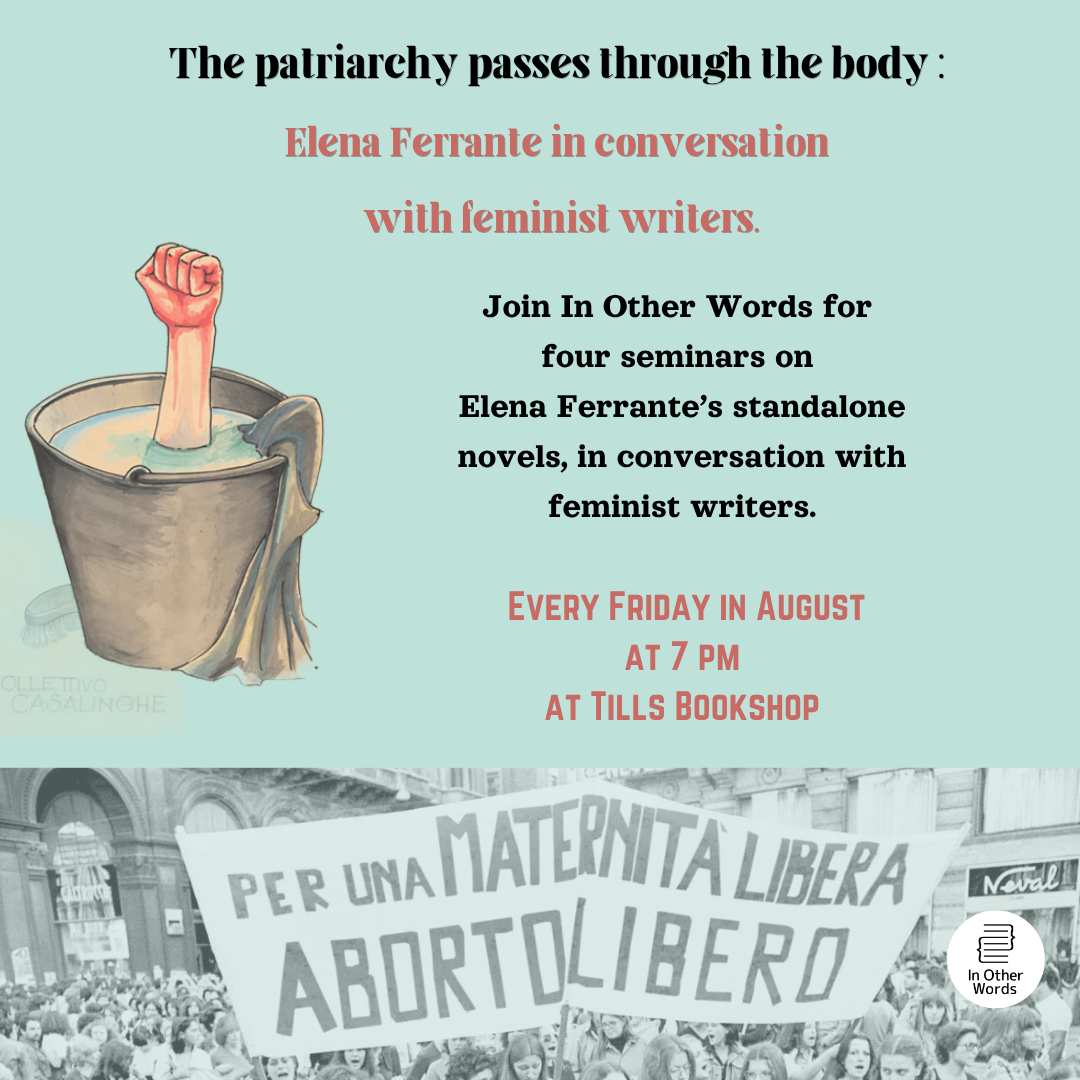
The patriarchy passes through the body: Elena Ferrante in conversation with feminist writers
For a third summer in a row, we are delving into the world of Elena Ferrante. This time around, our series of four seminars will focus on Elena Ferrante’s standalone novels, bringing them into conversation with feminist writing. We will read Troubling Love (L'amore molesto), The Days of Abandonment (I giorni dell'abbandono), The Lost Daughter (La figlia oscura), and The Lying Life of Adults (La vita bugiarda degli adulti), alongside the work of feminist writers whose work we love.
Across these four short novels, Ferrante tackles questions of desire, heartbreak, the violence inflicted upon women within a patriarchal world, grief, the relationship between mothers and daughters, the gendered, unforgiving, labour of parenting, the connections between language and class, in her effort to chronicle the lives of women. And while Ferrante’s protagonists grow up and grow out of the specific conditions of the Italian South, we find that these experiences translate across geographical and temporal boundaries.
This August, we will meet every Friday (7, 14, 21, 28) to discuss friendship, dissolving margins, and motherhood, while also working through questions of translation, class, gender, sexuality, as well as other emotions and ideas these novels have ignited.
We invite you to join us, whether you’ve read the novel discussed each week or not! Each conversation will be open to all levels of familiarity with Ferrante’s work and we will provide passages from the novels themselves, as well as excerpts from other texts, that have informed our own reading. As always, we invite you to read Ferrante in the original Italian, Ann Goldstein’s English translation, or any other language through which you encountered her work. Translation, and its impact on our reading of Ferrante, will be a major theme throughout our conversations.
We will meet at Tills Bookshop by the Meadows for an intimate discussion, surrounded by second-hand books at 19:00 on August 7, 14, 21 and 28. Join us for another Ferrante summer!
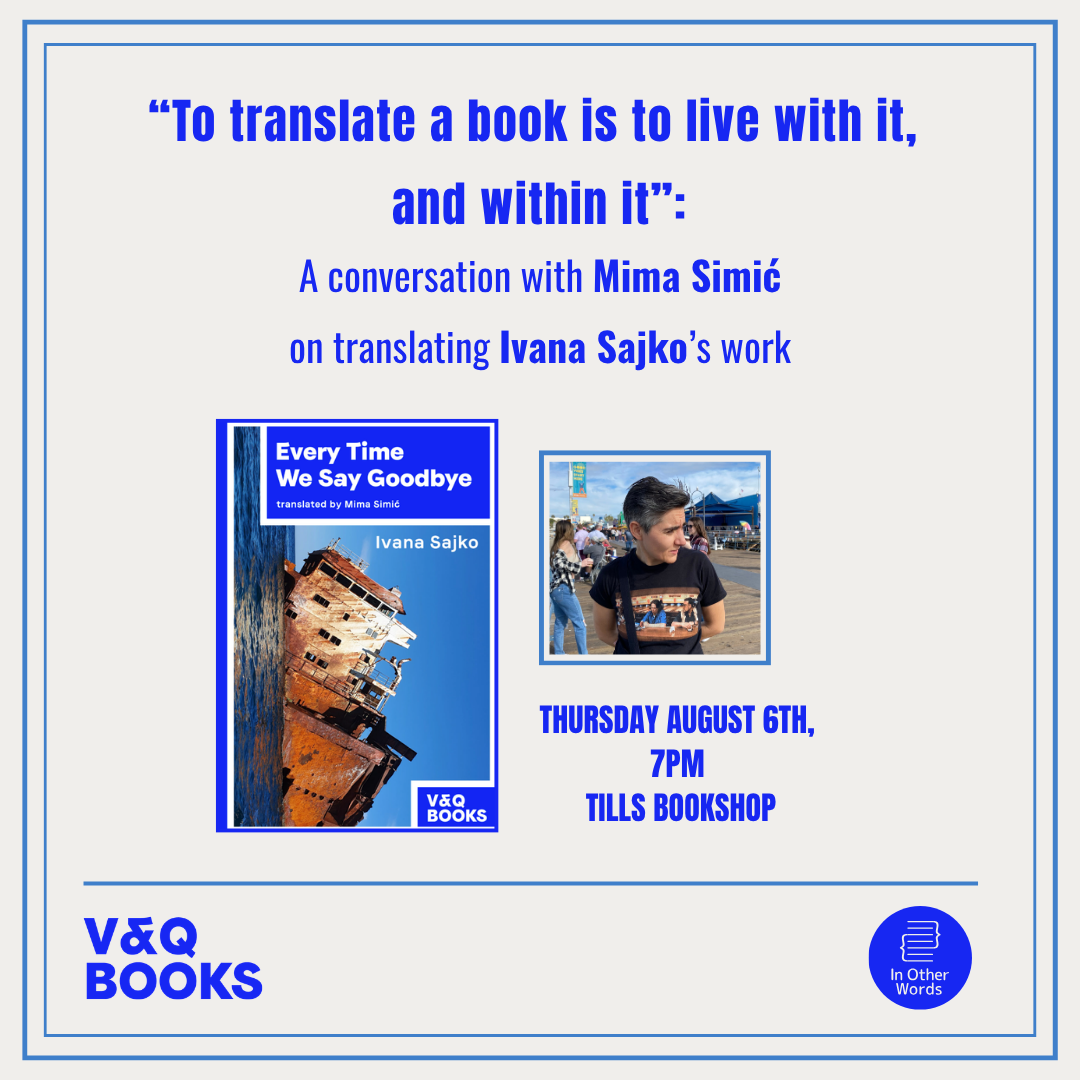
“To translate a book is to live with it, and within it”: A conversation with Mima Simić on translating Ivana Sajko’s work
“Because to translate a book is to live with it, and within it, constantly; to inhabit its images, rhythm, its (a)tonalities, its intricate hurts and grievances, its cultural knots that keep you awake at night, wishing for a sword in place of a dictionary.”
We are so excited to welcome translator Mima Simić for a conversation on Every Time We Say Goodbye (V&Q Books), her ongoing collaboration with Ivana Sajko, placelessness and translation, and writing and translating from the margins.
Mima Simić is a writer, translator, film critic, and political activist. She has translated two of Sajko’s novels (Love Novel and Every Time We Say Goodbye), and is currently working on a third, all out with V&Q Books.
Join us on August 6th, at Tills Bookshop (1, Hope Park Crescent, EH8 9NA).
The event starts at 7pm, doors open at 6.45pm.
Tickets are £5 and redeemable against the cost of the book(s) on the night of the event.
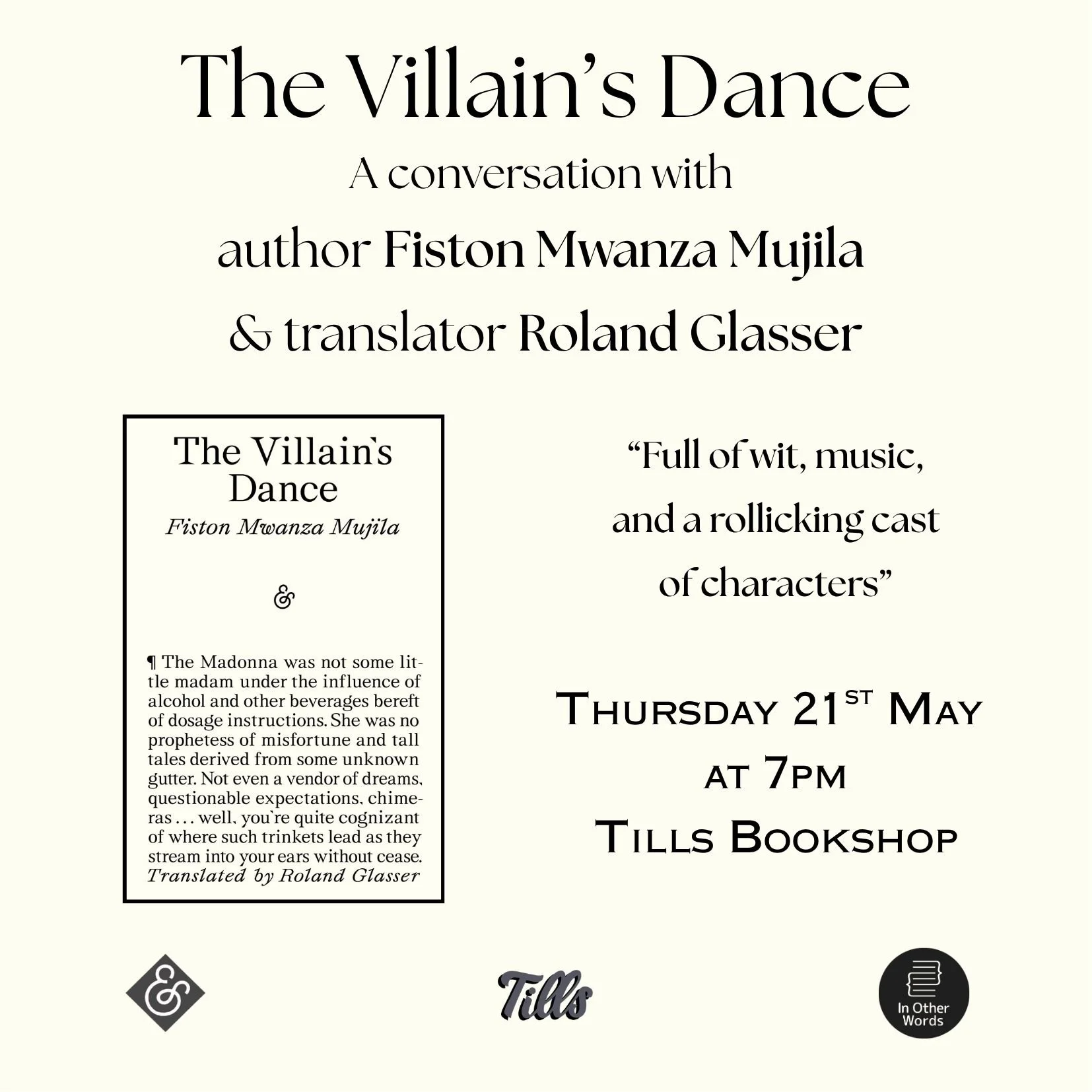
The Villain's Dance, a conversation with Fiston Mwanza Mujila and Roland Glasser
“Zaire. Late 90’s. Mobutu’s thirty-year reign is tottering. In Lubumbashi, the stubbornly homeless Sanza has fallen in with a trio of veteran street kids led by the devious Ngungi. A chance encounter with the mysterious Monsieur Guillaume seems to offer a way out… Meanwhile in Angola, Molakisi has joined thousands of fellow Zairians hoping to make their fortunes hunting diamonds, while Austrian Franz finds himself roped into writing the memoirs of the charismatic Tshiamuena, the “Madonna of the Cafunfo Mines.” Things are drawing to a head, but at the Mambo de la Fête, they still dance the Villain’s Dance from dusk till dawn.”
We are so excited to welcome both author Fiston Mwanza Mujila and translator Roland Glasser for a conversation on this electrifying novel, published by And Other Stories.
Join us on May 21st to celebrate the UK publication of Fiston Mwanza Mujila’s second novel, The Villain’s Dance, translated into English by Roland Glasser.
At Tills Bookshop (1, Hope Park Crescent, EH8 9NA). The event starts at 7pm, doors open at 6.45pm.
Tickets are £5 and redeemable against the cost of the book on the night of the event.
This event is supported by Institut Français in the UK
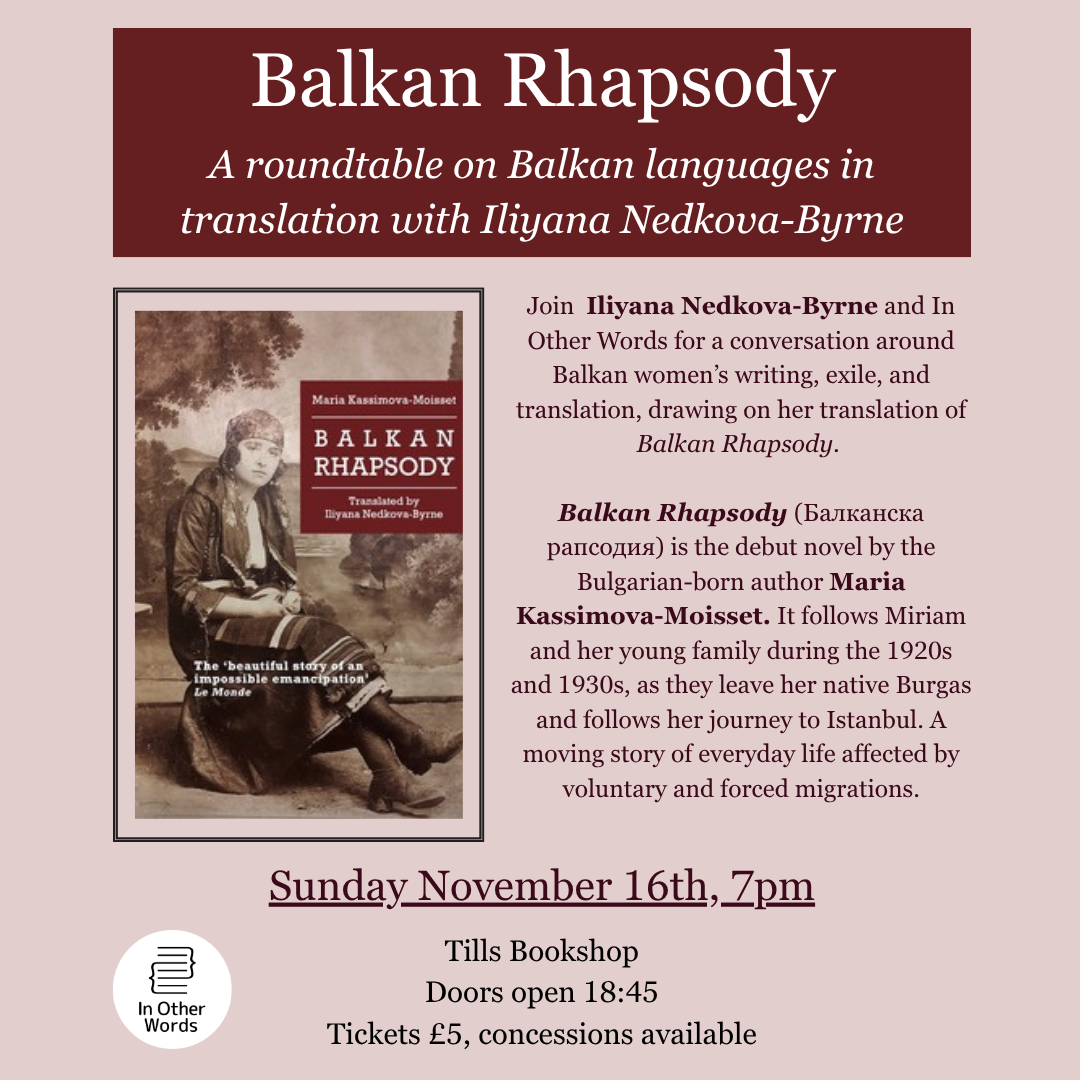
Balkan Rhapsody: A roundtable on Balkan languages in translation with Iliyana Nedkova-Byrne
Join Iliyana Nedkova-Byrne and In Other Words for a conversation around translation, Balkan women’s writing, and exile, drawing on her translation of Balkan Rhapsody, written by Maria Kassimova-Moisset, and published by the independent Scottish press Tippermuir Books in Perth.
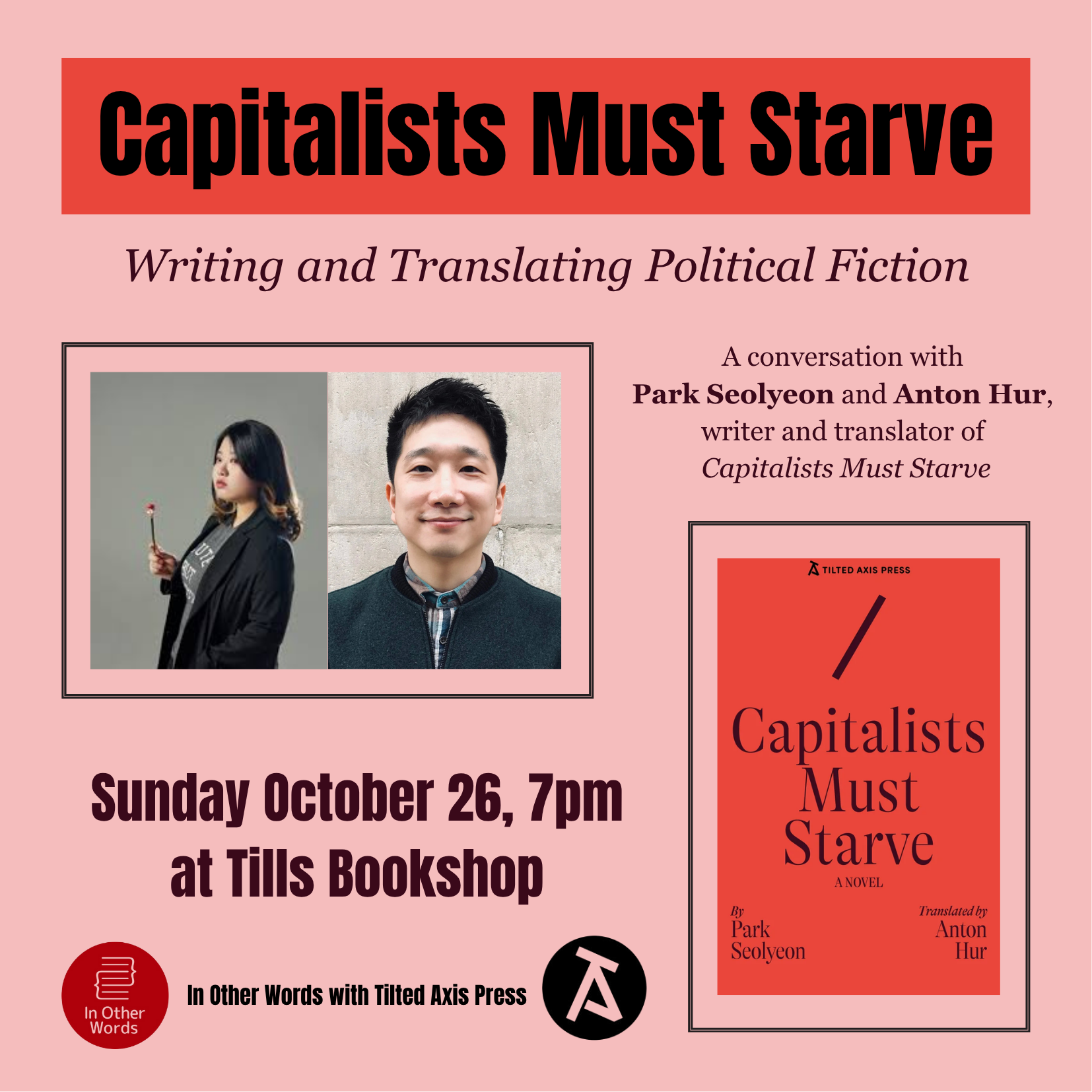
Capitalists Must Starve - a conversation with Park Seolyeon and Anton Hur
On October 26th, author Park Seolyeon and translator Anton Hur will join In Other Words at Tills Bookshop in a conversation about writing and translating political fiction, explored through their latest novel: Capitalists Must Starve.
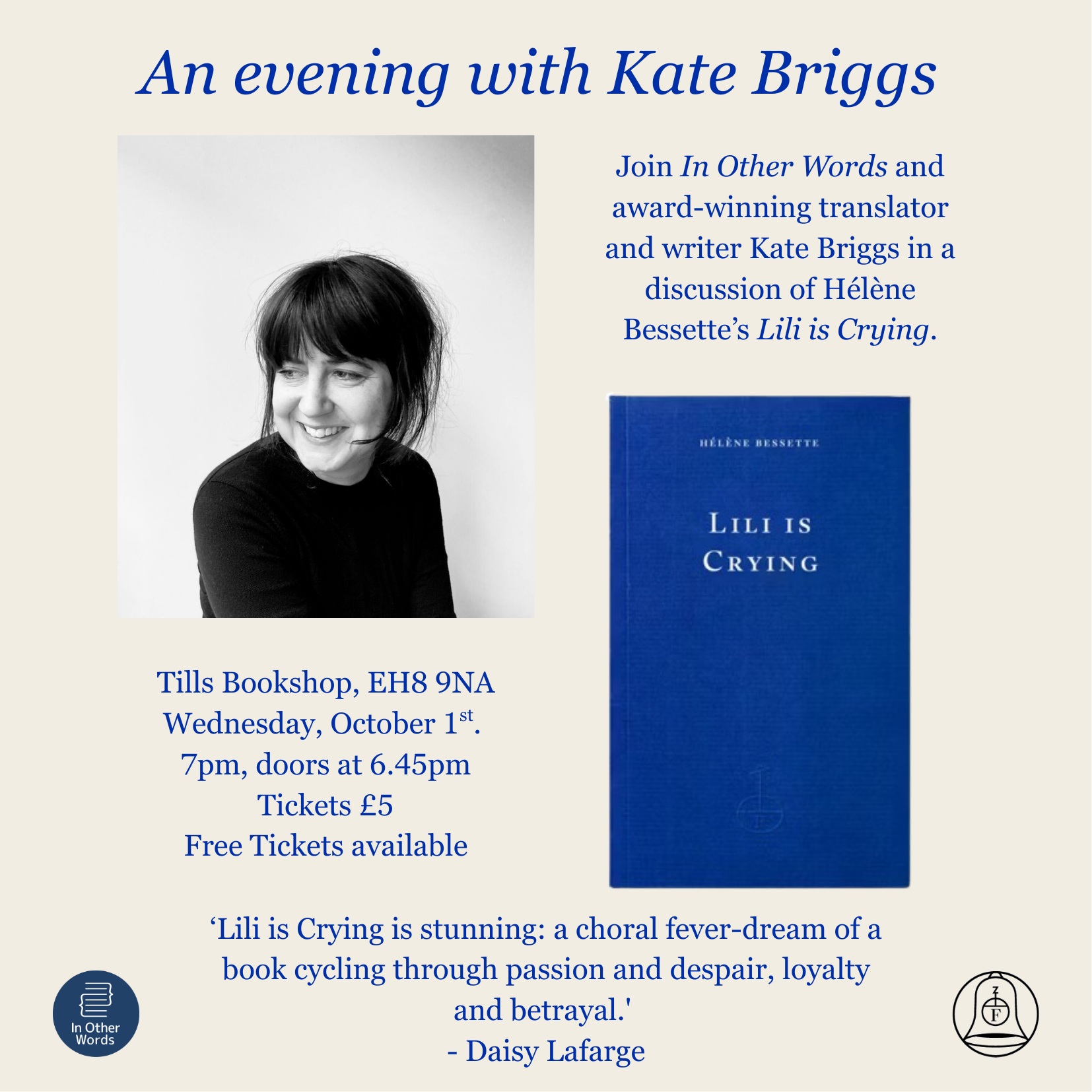
An Evening With Kate Briggs
Join us at Tills Bookshop for an evening with Windham-Campbell Prize-winning author and translator, Kate Briggs.

Woman, Idle: Laura Vogt in conversation with Annie Rutherford
Join us for the Edinburgh launch of Laura Vogt’s latest novel to be translated into English: Woman, Idle. Published in the UK by Héloïse press and translated by Caroline Waight, Woman, Idle explores two main questions: What kind of woman have I become? What kind of woman do I want to be?

Crossing Terrains: A discussion on translation, the natural world, and colonialism with Nedra Rodrigo.
Join In Other Words for an intimate roundtable with translator Nedra Rodrigo about translation as a decolonial practice focusing on the land.

Our Brilliant Friends: Three Seminars on the Neapolitan Novels
For a second summer in a row, we are delving into the world of Elena Ferrante. This time around, our series of three seminars will focus on the Neapolitan Novels, which for many has marked the entry point into Ferrante’s Naples. Published between 2011 and 2015, the four novels follow Elena Greco and Lila Cerullo over the course of their sixty-years-long friendship. The world of the Neapolitan Novels have changed our reading lives, and the way in which we understand authorship and translation. My Brilliant Friend, the first novel in the series, topped The New York Times Book Review list of the 100 Best Books of the 21st Century. A television adaptation directed by Saverio Costanzo has garnered critical acclaim, and Ferrante’s success has created renewed interest in the writing of Italian female authors.

The Translation Table at the Feminist Library, Florence, 2025
The Translation Table, our reading group dedicated to translated literature and literature about translation, is running a special series of events at the Biblioteca Femminista, in Florence. Held in a historic feminist space in the city, and directly supporting its work, the focus of our discussion is the complex ideas surrounding the translation of literature. Our group is made up of poets, professional translators, students, and folk that enjoy reading translated literature. Moving between Italian and English, our conversations have focused on four works we chose with love:

Chronicles of a Heartache - four seminars on Elena Ferrante’s standalone novels
Chronicles of a Heartache is our series of four seminars that took place over the summer of 2024. Each session explores one of Ferrante’s standalone novels: Troubling Love (L'amore molesto), The Days of Abandonment (I giorni dell'abbandono), The Lost Daughter (La figlia oscura), and The Lying Life of Adults (La vita bugiarda degli adulti).

Translation Table - Diamela Eltit, ‘Never Did the Fire’ (trans. by Daniel Hahn) and Daniel Hahn, ‘Catching Fire’.
Never Did the Fire is a peculiar novel, full of ambiguity, strangeness and repetitions.
Eltit’s experimental style has, throughout her career, gone hand in hand with her political commitment: elements of it, for example its ambiguity and strangeness, seem to have even been instrumental, at times, to bypass the censorship. How to translate this language, so embedded in its time and circumstances?

Translation Table - Sharon Dodua Otoo, ‘Ada’s Realm’ (trans. by Jon Cho-Polizzi) and Ngugi Wa Thiong’o, ‘The Language of Languages’
As a consequence of colonialism, the relationship between languages is often a hierarchical one. In "The Language of Languages", Kenyan writer Ngūgī Wa Thiong'o addresses this issue from a variety of points of view, and ultimately suggests the idea of a network of languages instead, with translation at its centre, where "all languages end up giving to and taking from each other, laying the groundwork for a complex independence and interdependence within and between cultures". While this might be only something we can dream about for now, it is without a doubt a great way to think about translation and its future. This idea is also explored by Jon Cho-Polizzi, translator of Ada's Realm: "On a historical scale, translation is intrinsically tied to projects of colonisation – attempts to extract greater profit or maintain structures of power through controlling access to the language and culture of the colonised subject." Translation theory itself, Cho-Polizzi states, has historically been a eurocentric discipline which should be decentralised.

Translation Table - Shushan Avagyan, ‘A Book, Untitled’ (trans. Deanna Cachoian-Schanz) and ‘Violent Phenomena’ (ed. Kavita Bhanot and Jeremy Tiang)
To read A Book, Untitled is no mean feat. On both levels - that of Avagyan’s original writing, and through Cachoian-Schanz’s translation, Book or Girq (as it is known) asks its readers to accept the uncomfortable feeling of not being able to always understand what is going on, or to be sure of whose voice we are reading.

Translation Table - Mireille Gansel, ‘Translation as Transhumance’ (trans. Ros Schwartz) and Yoko Tawada, ‘Scattered All Over the Earth’ (trans. Margaret Mitsutani)
Both Yoko Tawada’s Scattered All Over The Earth (tr. Margaret Mitsutani) and Mireille Gansel’s Translation as Transhumance (tr. Ros Schwartz) deal with the idea that language and identity are interconnected and able to create, transform, and mould each other in response to life experiences. Each writer reflects on experiences of forced displacement, either personal or fictional, and through these works they explore what it means to lose one’s native language and be forced to rebuild one’s self around, and through, an entirely new one.

Translation Table - Kate Briggs' 'This Little Art'
This Little Art is a dense, bold and thought-provoking essay which explores translation in a very personal, heartfelt way. It can be a great introduction to complex ideas about translation as it makes the reader feel intimately involved in the translator’s world.