
Talking with Nguyễn Bình
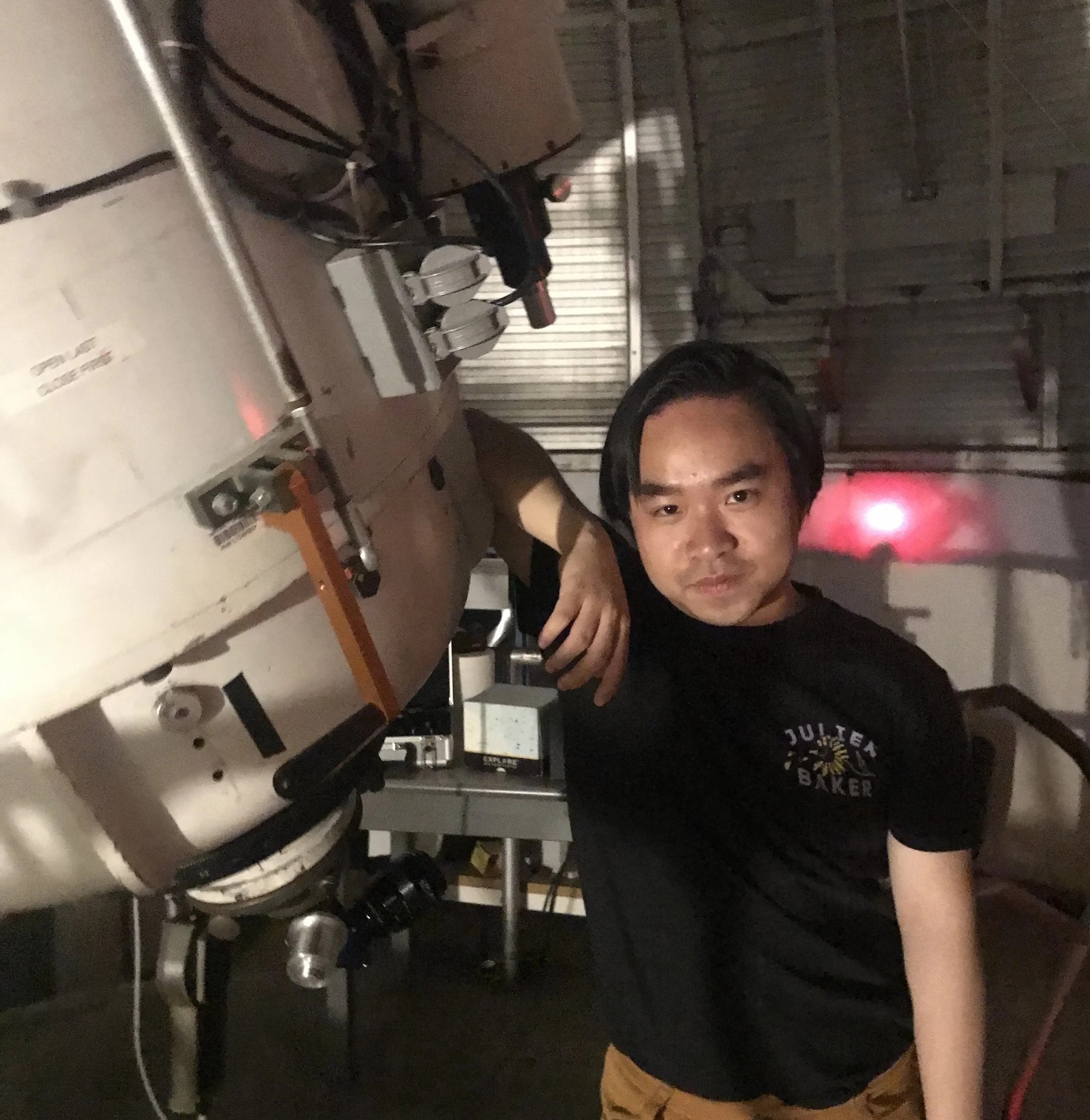
Georgia Katakou and Kate McNamara talk with Nguyễn Bình, a poet, writer and translator native to Vietnam. We discuss their recent translation of the Vietnamese classic, The Tale of Kiều.
The resulting lively conversation moves between the colonial history of translation, a critique of the existing versions of The Tale of Kiều and the politics of re-translation, and how to translate epic poetry.
Kate McNamara: Hello Binh! You recently translated The Tale of Kiều - this is such an important text in Vietnamese culture, and I would imagine quite an intimidating translation project to take on. I’d love to hear you talk about what inspired you to translate The Tale of Kiều?
Nguyễn Bình: I guess there are multiple inspirations. That’s the way that a lot of literary work – at least the work that I do – has been, I'm inspired on multiple levels. I think the most important inspiration for me with Kiều is the personal connection that I have to it. I started out not really liking it when I first started learning it in middle and high school. I was like, this sucks, this is so archaic, I don't care about this period. But then, as I grew older, I started to appreciate it more because I could feel an attachment to this emotionally chaotic poem, where the protagonist is going through all of these ups and downs and feeling a lot of things. I think the most important point in my journey was when I moved from Vietnam to the US for university, and for the first time, I was far from home. I was lonely, and I remembered some of those excerpts I’d studied in middle and high school, and I told myself: I want to read this thing in full. After reading it, I also wanted to do something about it, do something with it, in order to bring it over to the new Anglophonic world that I was in. That was my biggest motivation.
And the second motivation is the form itself. While I was hating on Kiều in high school, I was also getting into modernist poetry, both in Vietnamese and in English. And I was also a poet myself. I still am, but I just don't write much anymore. But I developed this affinity towards English poetry because that's the second language that I could speak in and understand, and over time, I went from Marianne Moore and T. S. Eliot, all the way down to Shakespeare and those guys. And I wanted a place where I could have these interests overlap: this burgeoning appreciation for medieval poetry in Vietnam, and this interest in English poetry. I could try to make them merge. And I think The Tale of Kiều is the culmination of both of them merging.
Kate McNamara: There is so much that resonates as you're talking there. I think many people can relate to being taught key literary works at school, then coming back to these texts after education and experiencing them in a totally different way. It feels really lovely. I think it leads nicely into the next question that you are going to ask, Georgia, because that's what I'm yearning to ask.
Georgia Katakou: Absolutely. This is a poem that has been previously translated, most recently in English by Penguin, in 2019, but also a 1983 translation by Huỳnh Sanh Thông. How did these previous translations and their afterlives influence your undertaking of this project? Could you talk to us about the politics of re-translation?
Nguyễn Bình: So for me, translating this poem started out as a personal project – I thought I could try to experiment a little with it. As time went on, I started to understand the scope of what I was doing, adding all the annotations, and I was like, holy shit, this is beyond my control. So I started looking towards other translations to see what I might’ve done wrong, what they have, what I don't agree with or what I like about them, basically to try and learn from others.
The most interesting one for me was the Yale University Press version by Huỳnh Sanh Thông. He translated the poem into blank verse, like Paradise Lost. I found it interesting, and by then, I already wanted to translate Kiều into heroic couplets, because I really like Shakespeare and Alexander Pope. So, when I saw what Huỳnh Sanh Thông had done, it was like an affirmation: Oh, there's somebody Vietnamese who thinks like me. And his analysis of the original form is that it is ‘predominantly iambic’, and I agree with him too. Huỳnh Sanh Thông was a prolific translator, who covered everything from medieval to modern Vietnamese poetry into English, and he translated all of that into blank verse. But in my opinion, translating every Vietnamese poem into the same form that way is going to make the whole poetic tradition seem like it has remained the same. When it comes to the politics of translation, especially for a work like this, I want to emphasise on its historicity and its place in the canon period-wise. What this means is, I want there to be a historical succession, presented in the translation itself. So, for example, let’s use English as a reference: if I were to translate English poetry into another language, I would translate Shakespeare differently than Alexander Pope than Sylvia Plath. I would translate them into different forms, and I think that flexibility with form is something I also learned from W. H. Auden when I was reading his poetry. I was like, this guy knows a lot about form and can play a lot with form, and I want to be like that, but as a translator.
So I see form as a representation of historical periods of literature. But that’s not everything. I also want to give the translation an aura of the original period, and in order to give off that aura, I have to dig deep into the original and really put myself in the author’s eighteenth-century headspace. And in order to do that, I had to learn Classical Chinese, because a lot of the poem’s literary allusions came from Classical Chinese, and I had to consult the actual manuscripts that survived. There is this very common identity-politics idea thrown around in the literary world, where I translate this because I'm Vietnamese or I write this novel about some ethnicity because I'm that ethnicity. I think it is a motivating factor, but at the same time you're not an authority of a poem – especially something this monumental – just because you are that ethnicity. You wouldn't say that a random-ass Greek in Athens is the authority on Homer and the Hellenistic poets just because they’re Greek. And so, I want to be serious with the poem as well. That's why knowing Vietnamese and knowing the culture is a good start, but you also have to consult actual scholars. There are a lot of biases you have to unlearn along the way because medieval poetry is different from today’s poetry.
And since you mentioned the Penguin translation of 2019, I want to point out that it’s a disaster, a fucking disaster, a disgrace to Vietnamese culture, because it was translated by some white man who learned the language while translating and consulted mostly online dictionaries. (We can talk about how egregious that is.) And that kind of approach is diametrically opposed to all my points about understanding the original and its historicity, which requires you to be serious and painstaking with what you do. You shouldn't have the audacity to assume that you can do this no matter who you are. I think it felt very humbling to translate The Tale of Kiều, I feel a lot of imposter syndrome, and imposter syndrome can be terrible, but at the same time it can be something that humbles you.
Kate McNamara: Absolutely. I would like to follow on from your discussion of re-translation there, and ask you whether it was hard to convince a publisher to produce another version of this book when there were already two translations existing?
Nguyễn Bình: So, it was quite surprising, honestly. The publisher, Major Books, is this very small indie publisher run by Vietnamese people, both diaspora and mainland. The person who got in touch with me from the publisher was very pissed about the fact that the most popular version of Kiều at the time was the Penguin version, because Penguin inherently has way more advertising power than even Yale University Press, which publishes Huỳnh Sanh Thông’s blank verse version. She was mad that the Penguin version is so atrocious yet so commercially available, and so it wasn’t that hard to convince her to take on this project because she was like: This is in line with what I want. I think that's the good thing about working with indie publishers: you're not going to sell much, but they’re personal and passionate.
Georgia Katakou: And I think there's something about this that is also a kind of restitution. You're publishing a translation that is writing back to the most recent translation. There's something really powerful about that.
You also said that you consulted the manuscripts that survived in your process of translation and that really interested me. Can you talk to us a little bit more about what it felt like to consult the manuscripts? Did seeing the manuscripts change the way you translated The Tale of Kiều?
Nguyễn Bình: I guess you are asking what I found while I was looking at the manuscripts. I don't know if you know this, but the way I’m spelling my name is with Quốc Ngữ, the Latin-based alphabet for the Vietnamese language. This script was only promoted by French colonists in the early twentieth century, and the motive was to detach the country from the East Asian cultural sphere. And then, after the revolution won in 1945, the new government adopted and promoted this new script, both to improve the literacy rates and, I guess, to adapt to the times. The Tale of Kiều, on the other hand, was written before French colonization, in a Chinese-based script called Nôm, which is unfortunately obsolete today. Nobody really studies it or uses it anymore. And the shift from Nôm to Quốc Ngữ—you can take a guess at how confusing that was and how much was lost in translation, because the language itself changes from one script to another.
When I was reading the manuscripts – well, barely reading, because I'm not that fluent in Nôm – I was like holy shit. There are lots of debates about meanings of words in the current Latin-based version of The Tale of Kiều that could be settled with a snap of a finger by checking the Nôm manuscripts, some of which have been digitized by the Nôm Foundation. For example, there's a lot of archaic words in the poem that when you write them in the Latin-based script, they don’t make sense. People give multiple interpretations, but when you check the original, you're like: that's what it means! My favourite example, which I also used at a translation workshop in London this June, is how at the start of the poem, there’s a General Prologue-type section where the author introduces the protagonist and her sister, and the sister’s described as having ‘moth brows’. There are other interpretations arguing that it’s not really ‘moth brows’ because the word ‘moth’ (ngài) might actually be another word that was mistranslated into Quốc Ngữ. But, if you look at the actual manuscripts that survived, you’ll see that for most of them, the corresponding Nôm character is 𧍋, which is composed of the phonetic component ‘ngại’ and the semantic component that means ‘insect’. The idea is that the Nôm character is asking you, the reader, a question: what word is pronounced similar to ‘ngại’ and is insect-related? And as a Vietnamese speaker, you respond in your head: ‘ngài’ (moth). What this means is, all those fringe interpretations that don’t believe the word is ‘ngài’ could just be thrown out the window the moment you check the manuscripts. So, it was really enlightening, I’d say. It makes me think a lot about the progress of history and how much a text can lose meaning in the reader’s head when its language changes from one script to another, and also how much that has to do with colonialism. Because, as I said before, and as historians would tell you, one of the reasons France promoted the script change was to detach Vietnam from the Chinese cultural sphere.
Kate McNamara: That's fascinating that people were having these arguments without consulting the manuscript. It seems mad when the answer is just sitting there!
Nguyễn Bình: I know!
Kate McNamara: That's really interesting. Thank you for that. Our next question stems from a quote from when you were writing about your process of translation. Addressing the author of The Tale of Kiều, you said: ‘As for myself, I weep for you, but I want the world to be able to read your work and weep for you too. So here I am, trying my best to translate you, hoping to justify the ways of Nguyễn Du to the world’. Translators working with living authors can have a range of different relationships to them. We often ask people who are translating how much have they have engaged with the author, what their relationship was like, but obviously in this case you were unable to have any interactions with author, apart from these questions that you addressed to them in your head. So I was wondering what it was like to work with an author who is not alive today, but is still such a historical figure, and so present in Vietnamese culture?
Nguyễn Bình: Well, firstly, did you catch the Paradise Lost reference in that quote: ‘justify the ways of Nguyễn Du to men’? I think this is a really good question, thank you for asking this, because I thought about this and it's good to have somebody ask this. When I was eleven years old, I won this writing contest, and we took a trip from Hanoi, the capital where I'm from, to Nghệ Tĩnh, the region where Nguyễn Du was born, to tour his family memorial. And I didn't even know who this fellow was. I was like: why are we here? Why are we in the middle of nowhere under the scorching sun visiting this random-ass house and looking at these random-ass manuscripts? That kind of set the tone for my relationship with Nguyễn Du before I knew what his deal was. We were told to praise this guy and so approaching the poem can be very daunting. When I was in my first year of college, I remember telling my friends I don’t think I could translate The Tale of Kiều. It is just way beyond my scope. But at the same time, I still wanted to do it out of spite. Because if that shit-ass Penguin version and that white rando could do this while learning the fucking language, why couldn't I?
But even then, I try to tread carefully, because this is a poem whose lines and whose couplets, no matter how trivial, have been adapted to folk songs, used for clairvoyance, and appropriated for twentieth-century political propaganda, even used as pick-up lines in the medieval period for people to find partners. So, it has a life beyond even the author. You can't help but feel like every single word in the poem is sacred and you wouldn't want to stray too far from the original. But then the question is: how do you try not to stray too far? How much is too far? And so that brings me back to the author. I have to put myself into his headspace, and I need to understand his quirks, his figures of speech, his imagery, even the world in which he lived. For example, in line 769, there’s a dialogue about couples who aren’t meant to be, and instead of saying that directly, this guy instead pulled out this imagery about needles and seeds falling, which alludes to an observation of magnetic phenomena in the Lunheng, a very obscure Chinese treatise about the natural sciences. I was like: why are you talking about magnetism? So I had to trace down the Lunheng, and read the original quote a bit, just to see how it’s relevant, and how magnetism is comparable to couples breaking up.
So that’s what I meant by ‘tread carefully’. You have to try to understand why this medieval author wrote this way. It also doesn't help that I myself am something of a perfectionist… or is it just anxiety? And so, to understand the author and the context, I can’t just rely on hearsay or random sources without citations on the Internet. I have to actually acquaint myself with all the Classical Chinese texts that he alluded to, and go on these hunts to really make sense of things. So working with a historical figure as monumental as Nguyễn Du requires both rewiring your brain to sort of think like him, but also going on these wild goose chases to hunt down sources that in the end you might not even need and you might not even get to tell the reader like: hey, I had to dig this deep.
Kate McNamara: There are plentiful notes accompanying your translation, as well as annotations that bring in many of those sources, which is so helpful for a reader to follow the text, but it is also amazing on another level. You don't often to know about all of the extra reading that goes on behind the production of a translation, and seeing it demonstrates your understanding of the work, and displays your engagement with all of the sources and the text beyond it.
Georgia Katakou: Again, I am struck by how much historical work you have had to undertake to do this translation. The depth and intensity of the research, and the investigative work that you've done is really impressive.
Nguyễn Bình: Yes, thank you! For me, it could also be framed as an issue of wanting to bring the real deal out to the world, in contrast to how, for example, the Penguin translation doesn't cite any Vietnamese sources because the translator wasn’t even fluent in the fucking language. Even the Huỳnh Sanh Thông version—he was translating in the 1970s, and there were a lot of sources that were sketchy because there wasn't really an academia in Vietnam at the time. Much of the seminal academic work on The Tale of Kiều—like the stylistics analysis by Phan Ngọc, or the historical linguistics stuff by Nguyễn Tài Cẩn—only came later, around the end of the twentieth century. And so, now, I think, is the right time to translate, because I can benefit from the digitization of all the surviving manuscripts, and also an actually functioning Vietnamese academia. Also, I know the language well, so I can actually read and bring the discussions by real Vietnamese scholars out to the world, rather than just bumble around like that Penguin guy did.
Georgia Katakou: You've been describing the multiple levels of translation you've been doing: translating academic texts in order to provide all of this context, for example. Our next question is more about form and the tools that you've used. You explain that your decisions as a translator were ‘made with the view to affect the reader how the original has affected me as a reader from modern day Vietnam’. Rhyme and musicality seem central to this approach. What are the tools you use when translating poetry to preserve and re-create this musicality? Is this similar to when you translate prose? Or even in your own writing, in both English and Vietnamese?
Nguyễn Bình: So, I think the best tool for translating poetry like this is a sharp ear. For this translation, since most of the country was illiterate at the time, a lot of poetry would have been read out loud. So I rely a lot on just the sound of it instead of the text. And I rely a lot on rhyme and musicality, because I think those are driving factors in the appreciation of the poem back in the day. And for this translation in particular, given the time period, I wanted to translate it into something that also gives off the same medieval vibe as the original would, which is why I use heroic couplets which, as you might know, are somewhat similar to the rhythm of the original poem, based on my analysis and also Huỳnh Sanh Thông’s analysis.
And in terms of meter, if you want to make poetry in iambic pentameter, you really have to read it out loud to know what the rhythm is, where the stresses are, et cetera. So a very efficient method for me is just to read everything out loud, count the syllables, and I basically try to get myself familiar with the pentameter, so much so that nowadays I can hear it anywhere. I'm kind of haunted by it. I have this joke with my friends about ‘accidental iambic pentameters’ and it haunts me to the point that the other day I was listening to a pop song—I think it was Olivia Rodrigo’s “Brutal”—and I was like, shit this is iambic tetrameter. So that's a running gag that I have with my friends – accidental iambic pentameter or tetrameter – because I'm so haunted by this fucking stress pattern now.
As for the comparison to my prose and poetry – I write in both Vietnamese and English, and that includes both poetry and a novel that I’m seeking publishers for. I also write some essays as well. But in general, I’d say that I try to do similar things as I did for this translation. For me, given my linguistics background, I know that writing is a very recent invention, and I think that the essence of language is speech, is communication rather than writing, so all of my works tend to emphasize the experience of reading out loud. That’s why I often read all my work out loud to make sure they sound nice—even if it's like a freaking academic paper on my astronomy research, I’d also read it out loud, even though that can be challenging because there's so much jargon in that. And another thing that I'm also doing is that I am currently working on, I guess, the first-ever translation of the Aeneid into Vietnamese. And I also translate that into a medieval Vietnamese form—not the same form as The Tale of Kiều, but equally old. I catch myself memorising the tone patterns of that form a lot. So, I think if you were to sum up all of my literary work, both my own writing and my translations, you could say it's all about the sound.
Kate McNamara: That really comes through in your translation of The Tale of Kiều, so it was something that we were thinking about as well. We've touched on elements of the next question, but I wonder if you can talk to us some more about it. The Tale of Kiều poses significant challenges for the translator. You state in the Introduction and in your Translator’s Note that to recreate this work in another language requires loss: the loss of the sociolinguistic aspects of the poem, the loss of the ‘conspicuous musicality’ of the poem when it is rendered into a non-tonal language, the loss of its minimalistic conciseness. You say on this last idea that as soon as The Tale of Kiều ‘is translated into English, it both loses its melodies while being crammed with more words and drawn out into longer lines, like a brilliant primordial light stretched until it becomes just another bodiless microwave rumbling in the background of the universe’.
This final phrase kind of struck me as quite a discouraging sense of what the poem can become in English. While the act of translation necessitated loss, is there something that the poem gained in its translation?
Nguyễn Bình: So that was in reference to the cosmic microwave background because I'm also an astronomer and it's basically a comparison to the remnant light from the early days of the Universe, when everything was hot and condensed. To piggyback off of that analogy, I think inherently, if we look at translation versus original, the original would be like that hot, early days of the Universe when light was very bright. But a long time has passed ever since, and there's just no way to recreate that. The only way of knowing what the Universe used to be like is to study that microwave. I think the same relation can be seen with a work as old as The Tale of Kiều—or just any work where the original language is so different from the destination language. What I'm trying to say is that even though it might sound discouraging to be left with microwaves rather than bright gamma rays, it's still worth it. We could still extract a lot of information from that microwave. And I think when I write that sentence, it does have a pessimistic tone to it, but I also believe there is still a lot of hope and a lot of things we could recover from, once again, that microwave.
I think we talk about loss, and I think that despite all the loss, like this inevitable loss, what the poem gains, in my very humble opinion, is a sense of a new aesthetics. It is Vietnamese in essence, but English in words. And I see it as a linguistic, lexical experiment in the vein of what Nguyễn Du might also have wanted because when he was writing this, he was experimenting with language. And when I produce this type of translation, I also have to play with the English language and do creative things with it. I can't just translate things into a full-ass sentence. That's what I think matters, because a linguistically innovative poem would also require a linguistically innovative translation. It's like when you try to reproduce an experiment under the same conditions to verify and boost the results of the first experiment, rather than just harping on about how good the first experiment was. I'm talking a lot about science here. My science background is showing.
Anyways, I think that these risks have to be taken, and I think when you do a translation, you're always going to take some risks. I think what matters is which risk you think is worth taking. You could have the risk of misunderstanding the whole poem because you don't know the freaking cultural context, but I don't want to take that risk. That's a stupid hill to die on. And so, I take another risk, which is experimenting with the English language. Even the footnotes and the endnotes, the way that I insist on having the para-text so adjacent to the text, it provides additional context that the reader might not have known, and it's also filled with my own takes on the poem, and so I think it is also a good addition to the scholarship. If you don't know, there is an actual field of study in Vietnam called Kiều Studies.
Georgia Katakou: Interesting! I’d like to delve deeper into this idea of faithfulness to the original. Reading your notes throughout the translation felt very useful and exciting to me. It is thrilling to feel the presence of the translator in the text. In part four, for example, you mention that there is a moment of wordplay that is lost in translation, around the double meaning of ‘bạc’, which means both fragile and silver/pale. And it is enticing to have small sections of the original Vietnamese text to compare the English translation to. Not being able to understand the original, it often made me wonder what the literal translation of the words would be like in comparison to a translation in verse, like your own. You say in the Translator’s Note that when reading Dryden’s version of the Aeneid, you doubted its faithfulness, given how forced some of the rhymes appeared, but then you went back and learnt from him, and from his use of heroic couplets. I wonder if you could talk to us about your understanding of faithfulness to the original, in the context of this poem. And about the responsibility of the translator to both versions of the text.
Nguyễn Bình: I published an essay in 2021 about this faithfulness idea in Vietnamese. When I think about translation, I see the relationship between an original and a translation as an asymptote. An asymptote is like a line, usually vertical or horizontal, that the graph of a function always heads towards but never overlaps, never intersects. It just keeps going! Sometimes the graph of the function takes on a very weird, unconventional-looking path just to get close to the original, the asymptote, without ever actually touching it. I wrote this essay in 2021, where I compare the translation to the original as the asymptote. The translation is a function that tries so hard to reach the asymptote but never could. I didn't know when I wrote it that there was already an Asymptote magazine, just about translations. I was like, damn I'm not original [laughter].
But that's what I see a translation as: a function that always, always tries to get to the asymptote but never actually crosses it. But how do you define an asymptote? How do you reach for such a noble goal? To get close to the asymptote, you have to push the function. As I said earlier, you have to kind of re-mould the function. You have to warp it so much that at one point, you just need to accept that the function may look weird. This is true in math: conventional functions like the quadratic look very, well, conventional, just a parabola, and they don’t have an asymptote. But the weird-looking, snakey-looking ones do have asymptotes. And the same goes for translations. The way I see it in terms of translation is, unconventional translations are what can get us closer to the asymptote, to the original.
Just for example, if you translate The Tale of Kiều into prose, that's going to stray so far from the original, because it’s neglecting the rhythm, the musicality, everything, Or if you translate the Iliad into prose, that's not going to be how it would have felt in Ancient Greek. So I think that's what I've come to terms with, that if you want to get close to the original, you have to bend yourself. That's how I see faithfulness. It's like an abstract goal that you have to bend yourself towards in order to reach. And I think that if you can try to be unconventional, it will make the people think more, and they're not just going to be blindly consuming the literature. By making them think more and want to know more about the original, then you are doing a better job at promoting the original than when you just produce a conventional translation.
Kate McNamara: I like how you’re saying there that just by stretching what is normal in the English, moving away from what the reading public might expect, you are making people think. You're drawing their attention towards those differences, and that perhaps it should be that way. In your writing you have described the translator as ‘the biologist of the humanities’. What do you see the role of the translator being? And more broadly, could you talk to us a little about the politics of translation, both in how you perceive the state of translation as work currently?
Nguyễn Bình: Retroactively I would say more specifically that the translator is the zoologist of the humanities. I was reading these stories about animals in captivity and how basically the biologist or the zoologist's role is to help the animal adapt to the new environment and ensure they could live in the new environment whether it's a zoo or a natural reserve. Like, in 2020, there was a raccoon that somehow sneaked into a refrigerated container in the US, and it went all the way to Saigon. And so when the workers in Saigon opened the container, they found a live racoon, and they didn’t know how to deal with it, and the zoologists who were called to the scene were confused as well, ‘cos raccoons aren’t native to Vietnam, and I guess the food they usually eat in the US is also not in Vietnam. But also, the raccoon has come a long way, so you have to keep it alive, you have to help it adapt. And I think every work of literature is like that raccoon, and the translator is the zoologist. They have to find ways to help it adapt.
For example, when I was translating The Aeneid, how the fuck do you deal with the kinship terms in Vietnamese? When Andromache meets Aeneas in Book III, how is she going to address herself? Is she going to be chị, sister, since she’s Aeneas’s wife’s sister-in-law? Is she going to address herself as if they’re not family? You're bringing a text that is not loaded with familial terms, into Vietnamese where your relationship with strangers is defined by age and by how old they are compared to your immediate family. So you have to find ways to help the text adapt. You need to be familiar with both environments—the original and the destination—to see what works. If you just know one environment, if you only know about the destination language and you don't know about the original, you might as well feed the wrong thing to the raccoon and kill it, the way the Penguin translation did.
Kate McNamara: That is a great analogy. How do you feel about the current state of Vietnamese translation into English? Is it an exciting scene?
Nguyễn Bình: I can only speak for the translations that I have read and have known. The Vietnamese-to-English pipeline right now is frankly dominated by white men who seem very self-assured about their craft and tend to make themselves the authority of these Vietnamese texts. Both that Penguin translator and even some American professors—they make themselves the centres of these discussions despite sometimes not even being fluent in the fucking language. And like, they’re not really the majority, but they are the loudmouths, which I think is a disgrace. I think we should evolve out of this. We should know both languages deeply in order to help the text adapt from one to the other.
For example, there’s this famous Vietnamese novel, The Sorrow of War by Bảo Ninh, which is about the Vietnam War from the North’s perspective. The most available version right now was originally translated by Phan Thanh Hảo, a diplomat from the Ministry of Foreign Affairs who lacked the literary background but worked closely with Bảo Ninh to capture his nuances. Hảo was convinced by someone at The Guardian to send her work abroad, and so she gave it to Frank Palmos, who’s an Australian war correspondent. But then Palmos rewrote a lot of the novel for Western sensibilities and ran away with the royalties, and Hảo was so angry about it that she said she went to the UK and signed a quit claim with the publisher to remove herself from the equation. I knew this from an interview she did in 2020. It’s disgraceful the way she was treated.
But anyway, I wanna focus on what Palmos did. So in 2010, he was at a conference in Australia where he basically admitted he wasn’t fluent in the language, but rewrote lots of things because Bao Ninh has different cultural sensibilities and he wanted to ‘Westernize’ the work for a new audience. What’s worse is, he even said he was re-translating in the style of Edward FitzGerald, the guy who translated the Rubáiyát of Omar Khayyám. Why are you openly admitting that you’re copying the orientalist? That would drive Edward Said crazy! But unfortunately, that’s the state of translation from Vietnamese literature, because nobody cares about Vietnam, honestly. These days, in the Middle East, I’ve seen actually acclaimed translators from the local languages being able to reclaim their literature, like the later translators of Omar Khayyám. But for Vietnamese, we haven't got that many people fighting back. And so I hope that one day, me and my friends in translation can try to challenge that, because this is not how language should be translated, not by people with very orientalist views of the language and the culture.
I am very passionate about this topic. My dad’s a personal friend of Bảo Ninh, and I do wonder how he feels when his novel’s been so bastardized and misunderstood in the English-speaking world, just because of some bullshit handwavy editor. The guy misunderstood the superstitions and the ghost stuff, and he added historical details that weren’t even there in Bảo Ninh’s novel because they never happened. He’s literally clueless about both the culture and the history, and then he tried to cram some more anti-communism into the book. So, it ends up being this oddly ahistorical, anti-communist novel, when Bảo Ninh himself wasn't that controversial. He wasn't even that anti-establishment, although politically, we could talk about what it means to be anti-establishment. But what I care more about here is why would you be such an idiot to impose your slant upon the novel and take away all the cultural nuances, especially the ghost stuff, which I think is an important theme in the novel because it talks about postwar trauma.
Georgia Katakou: This also ties back to everything you've been saying about responsibility and treading carefully and doing this careful, deep study while translating. I am sure this also ties into the politics of money and who gets paid to do translations. More translators from Vietnam and the diaspora should have funding to do their own translations.
One question that we like to ask each of the translators that we interview is whether they have any soundtracks to the works they translate, with music either from the language/culture that the book is steeped in, or with music suggested by the writing itself. Or perhaps you had certain music playing on repeat while you were working on the text. What is the unheard sonic background to the translated work that we get to read?
Nguyễn Bình: There are a lot of sonic backgrounds, I would say. I usually look for songs with lyrics that put me in the same headspace to translate. They have to touch on the themes that I find very relevant to the poem or to the excerpt that I'm working on. The most prominent name would be Mitski. She is a Japanese-American artist—literally an artist, and arguably a poet in her own right. And her meditations on the body and a lot of the existential themes in her lyrics are very much in line with The Tale of Kiều, even with the thoughts that Kiều has in the poem itself. So I really enjoyed translating while listening to Mitski, specifically her two albums Puberty 2 and Bury Me at Makeout Creek. I feel like if Kiều was a real person in the twenty-first century, she would like Mitski. And another English-speaking artist that I find relevant is an artist named Weyes Blood. She has an album called Titanic Rising which I think is just very dreamy and ambient, and a lot of the images are also very surreal, and it talks about how you live in and navigate through this chaotic world. So I sometimes have it in the background as I translate. Anyway, I usually look for songs that have deep introspective lyrics but are also very emotional, which is why I mention those two people.
I also listen to some Vietnamese artists as well. I grew up on the music of Trịnh Công Sơn, who was a twentieth-century poet and musician/composer. I see him as a modern continuation of Vietnam’s poetic traditions, he was living in South Vietnam and adapted to that time and place. And then a contemporary Vietnamese musician that I really enjoy is Cá Hồi Hoang, who unfortunately disbanded in 2023. They talk a lot about this kind of nostalgia for youth, which I think our protagonist also feels. And occasionally, because this is not on Spotify, but sometimes I also dabble in some Vietnamese folk songs of the quan họ style that actually are adaptations of The Tale of Kiều itself. So yeah, there are a lot of sonic backgrounds to it.
Kate McNamara: Thank you so much. We really love listening to the songs that translators suggest in these interviews; it brings another level to our engagement with the translated work, and the work of the translator.
The final questions that we ask each of the translators we interview is for some recommendations of books. Is there a piece of writing that has guided you during your translation work or a text or an idea that you keep returning to?
Nguyễn Bình: Oh, there's a lot! I think a book that I keep returning to is not in English. It's an author named Phan Ngọc, who was also a family friend and my dad's mentor. He passed away in 2020, but he wrote this book about the stylistics of The Tale of Kiều. I cited that a lot in my translation because he looked at the poem through the lens of style and tried to understand why the author wrote it this way, and it informed my perspective on the poem a lot. Another text in English that informed my translation is Matthew Arnold's On Translating Homer, even though I take a road that Arnold would not have liked. I definitely enjoy the way he compares a lot of the translations of Homer and he points out what they do and do not. As a translator who is trying to translate a very old text, you can't help but try to learn from the old ones. Not just the people who have translated Vietnamese literature, but from other ancient languages too because Kiều is on the same level as The Iliad or The Odyssey for Vietnamese culture.
Georgia Katakou: Is there a book that has been translated into English that you would recommend for people to read? And what is a book that has not yet been translated into English that you think should be translated? And/or is there a book that you think should be re-translated?
Nguyễn Bình: A book that I would like to see translated is actually not medieval. I mean, I am working on medieval stuff. But a book that I really, really like to see translated in Vietnamese literature into English is a book called Chuyện ngõ nghèo by Nguyễn Xuân Khánh. It was written in the 1980s after the war, and wasn't published until 2010. This is a very seminal work of postwar Vietnamese literature, and it talks about the conditions in the North after the war, but also criticises all the ideas of the authoritarian state. There’s these last chapters that are basically Brave New World but with a Vietnamese socialist spin, and it's surprising that it is so explicit! For me, this work is better than 1984 because it's written by someone with a better, more specific, and more intimate understanding of authoritarianism than a casual passerby like Orwell. So I think that's something that should be translated into English. And a work that I would like to see re-translated is definitely The Sorrow of War by Bảo Ninh.
Georgia Katakou: Amazing. Thank you so much, Bình. This has been a really exciting and thought-provoking conversation.
