
Talking with Mima Simić
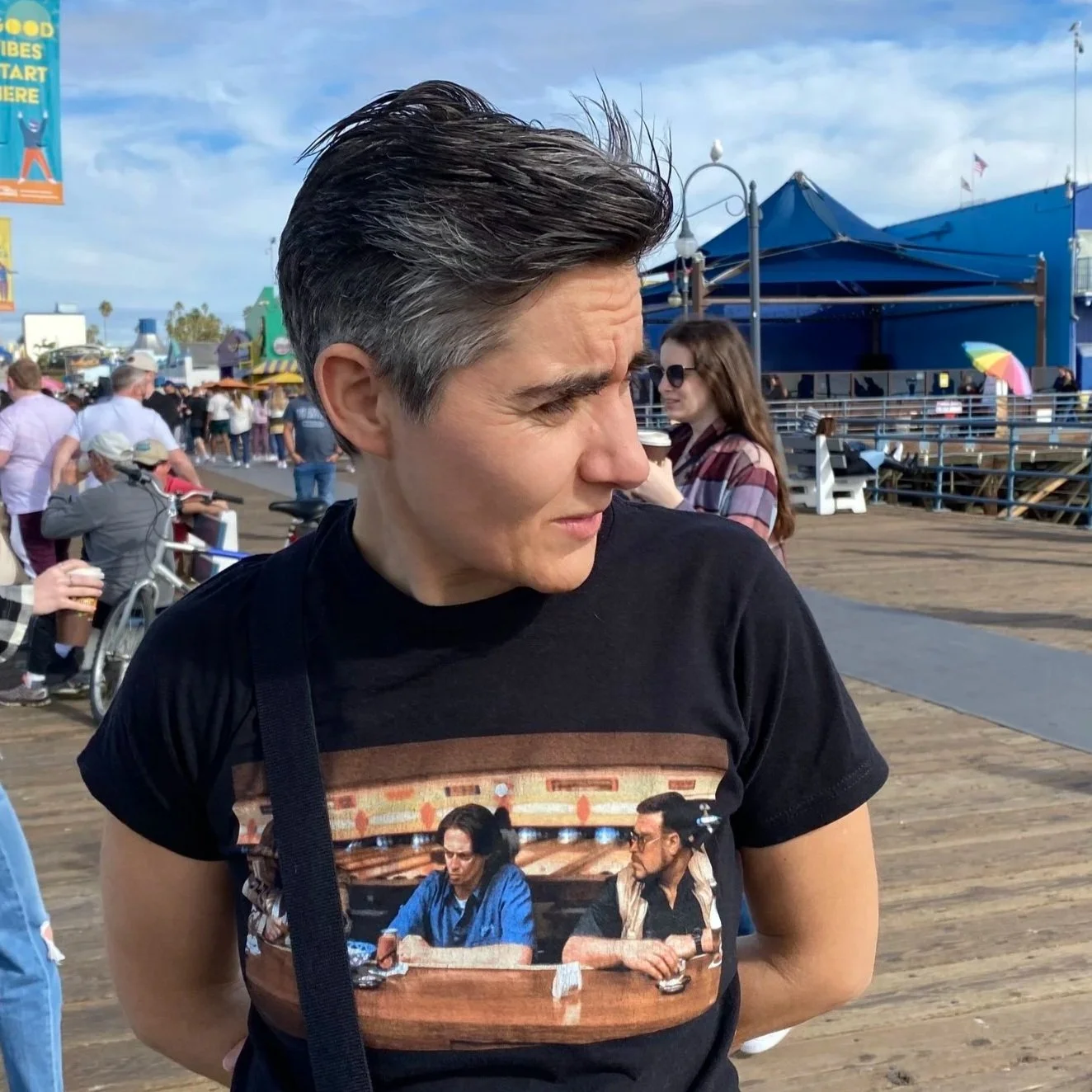
Georgia Katakou and Claudia Marzollo talk with writer and translator Mima Simić about her translation from Croatian of Ivana Sajko’s Every Time We Say Goodbye, published by V&Q Books.
We discuss the challenges of translating the melody and rhythm of a book, writing and translating from the margins, and the experience of sharing a micro-universe with the author.
[Photo credit: Bronwyn Lewis]
Claudia Marzollo: How did you come to translate Every Time We Say Goodbye? You translated another of Ivana Sajko’s works, Love Novel. It would be really lovely if you could talk to us a little bit about how this came to happen.
Mima Simić: I’d known Ivana from Croatian cultural circles for many years but we actually became friends after we both moved to Berlin about ten years ago. When we hung out, we also talked about literature, of course. At the time, I was not a full-on translator but my limited output and the way I approached language was enough for her to clock me as her personal translator into English. So she roped me in for Love Novel and – also thanks to our amazing editor Katy Derbyshire who held the whole structure together and made sure there were no leaks in my translation – we were shortlisted for the Dublin Literary Award. So it was the most natural thing for me to translate Every Time We Say Goodbye. What is more, the wheels keep on turning as we speak, as I am currently translating her latest novel, The Last Day of the Peace.
Georgia Katakou: It’s so wonderful to hear that your collaboration is ongoing! The original title of this book is Male smrti – ‘Little Deaths’. Every Time We Say Goodbye makes a lot of sense to us and Claudia shared that every time she read it, the line from the Cole Porter song came to her mind: “every time we say goodbye, I die a little”. The song actually kept playing in our heads as we read the book. Can you speak to us a little about the choice of Every Time We Say Goodbye as the English-language title?
Mima Simić: Well, we all thought ‘Little Deaths’ would give the wrong kind of expectations to the readers. The book might be very orgasmic in style, but it’s not really sexy, I have to say. So we had to radically depart from the literal translation; and since the German title was ‘Every departure is a small death’, this transition into English was natural. The song title, we knew, would be everybody's first reference and would bring a sense of familiarity, and potentially the impulse to reach for the book. As you know, you have to think about all the hundreds of books out there on the shelves, screaming to be picked up and held. In that sense, Every Time We Say Goodbye is an attractive title, and even though the song itself is much softer than this book, which is rough and punchy, there’s an emotional umbrella that they share. And, another thing is, Ivana’s text is all about rhythm and melody and on a meta-level it makes all the sense for the book title to refer to an actual song.
Claudia Marzollo: I love your translator’s note about the title, and you end it with “the life and death of translation” – it's really beautiful. I was wondering, did Ivana have an opinion on this new version of the title? What did she think about it?
Mima Simić: We were all brainstorming in real time over email and as soon as I pitched it, Ivana knew it was the one. And that was crucial, to have her blessing for the title. (Katy suggested Every Time I Say Goodbye but was outvoted). Actually, this is one of the best things about the collaboration with Ivana, and Katy – when I work on Ivana’s text, we are in touch all the time – and Ivana can give immediate feedback on my solutions. She can tell me when something doesn’t work for her, and why. And then Katy and I can figure out an alternative solution – which is a great system, and so far has been working perfectly. It is truly reassuring and soothing for everyone involved, and I don’t think it is discussed enough, the anxiety of having your text translated. How stressful and vulnerable it is to put your words into someone else’s hands and trust them to keep them as alive in the other language.
Georgia Katakou: There is a real difference between Every Time I Say Goodbye and Every Time We Say Goodbye! Something that I really loved about the novel was that it had all these different layers of meaning. On the surface it’s about the breakdown of a relationship between a writer and translator. But to me it also felt very much like Ivana was writing towards a collective historical experience and picking the ‘we’ over the ‘I’ really makes that very strong. Even though it's about an individual kind of heartbreak, the novel is very much concerned with borders, European identity, memory, bearing witness, and history. There is one quote that really stayed with me: ‘When the war broke out, one of those wars that supposedly never happened during seventy-plus years of European peace’. This to me made explicit an undercurrent of this novel, which is showcasing the ways South-Eastern Europe is continuously marginalised and exploited. What role can translation and translators play in reimagining South-Eastern European history and bringing to light some of these tensions?
Mima Simić: Unfortunately, our wars of the 1990s have been one topic that has been particularly attractive, dare I say sexy?, to the international readership for some decades. So, if you’re a writer from our post-Yugoslav region, you enter into negotiations with your own (in)visibility. We can speak as long as we are speaking about our trauma, we can speak as long as we’re talking about the war. And what is great about Ivana’s position, or, rather, the position of her narrator: our wars are not in the foreground, he's talking about the violence that's happening elsewhere, to people trying to enter the fortress of Europe – which we have become part of. So now he's part of the centre in a way, even though he's still on the margin. You have multiple margins that are coming to the surface in this book. It's a constant negotiation! I love how carefully and delicately Ivana treads this territory, how she intertwines all of our wars past and present and effectively subverts the idea of margins – as violence has no borders, no centre. We know that only too well at this point of history when we can testify to it more than ever before.
And another thing, as challenging as Ivana’s writing can be to a translator, I think I’m the right person for the job because to me it really is personal. Ivana and I belong to the same generation, and the experiences and topics she deals with I have had myself and I really want them to be communicated as emotionally accurately as I had felt them and as Ivana is writing them. It’s like we are on a special mission together; it’s not a job, it’s almost a matter of survival. And, of course, this mission contains so many other missions – you might have a great book and translation, but then you need other people to get fired up about it – and push, and push, and deliver it to worldwide audiences (that’s why English translation, for better or worse, matters so much). Luckily, Katy is as passionate about Ivana’s writing as I am, and the excitement spread to the folks at Biblioasis, so there’s already an army of us, you could say. Or, a family, if you want to drop the military metaphor.
And, yes, back to the geographies of selves, it's shit to be on the margin, but also it's exciting because from the margin you can see more than from whatever the center is. We have that curse, and the privilege; much like Ivana’s narrator, we are both displaced from our own homeland and exploring the razor-sharp edges of the presumably borderless Europe. It’s tough enough to survive as a cultural worker in one’s own country, so Germany is a special kind of challenge…
Claudia Marzollo: What you just said is really interesting and we were thinking about how personal this novel feels to the actual narrator. The story is very personal, and it's very intimate, and there's a lot of heartbreak, a lot of grief. What I loved about it is that this heartbreak from his relationship is connected to his family history and it is connected to how he feels about the state of the world, to what he's investigated in his role as a journalist. The loss of himself and the loss of his country are tied together. Everything is very connected and I really thought that was very contemporary. But you said it was very personal to you as well and to Ivana so I was wondering if while you were translating this novel and trying to keep this emotional truth to it, if you thought about how this grief and this heartbreak would resonate with and be understood by an international readership.
Mima Simić: I never think about it. I take it for granted because ever since I was a kid I read literature from all over the world, and I related to it all. Plus, I also studied literature and I know how reception works. So I had no doubt that even if cultural nuances are lost, it doesn't really matter. I mean take Arundhati Roy: I’ve never been to India, I don't know much about India, but the emotional impact, the universality of human experience as a common denominator will come across if you're a good writer. The cultural context can be an interesting backdrop, but as a reader you always fill in the gaps with your own experiences, with your own landscapes. So I don’t think much about readers out there – my first and last reader is Ivana. I want her to feel that I'm doing a good job and doing justice to her book. The rest of it, I'm always confident that it's going to work, because really this is what makes us human. The same emotional truths regardless of the context. And war is war. Sure, some wars are more brutal, some wars are genocide, wars differ in scale, duration, intensity, but the emotions of loss, of grief, of leaving, of breaking – all this devastation – it's very familiar to all of us who are human. I never have any qualms about this.
Claudia Marzollo: That's a great answer. Do you ever think about where the book is now and who is reading it?
Mima Simic: No, because every act of reading is different, even for the same reader. You can't control how, where, when, and in which mood a reader will engage with the text. You’ve got to let go of any such projection and just try to do justice to your own reading of the book and to the author, and the editor, who will give the seal of approval. And that is already a challenge in its own right. This, for instance, was the first book that Ivana has written that's from a male point of view. To me, as a translator, this gender dimension was one of the book’s bearing beams, it framed my reading, and translation. Much like her character, Ivana had to displace herself in text, as gender makes a lot of difference. It's a different kind of freedom (and constraint too) for the character. On the most banal level; setting the narrative off with the male protagonist in the train compartment is a completely different scene than if it was a woman in the same train compartment. It is simply a different universe of movement. In a certain sense, this narrative decision liberated Ivana when she was writing. In Love Novel the main character is a woman, artist, a mother, which shaped the narrative in a very particular way. So, back to your question, every reader, and me as one, comes into the narrative with their own baggage, their own identities (gender being one of them), their own projections and needs. I have enough of my own to think about theirs!
Georgia Katakou: I read Love Novel a few years ago and really enjoyed it. It definitely felt like a different narrative world than Every Time We Say Goodbye where every chapter is a single sentence, often leaving the reader breathless. There is limited punctuation and the style of writing is stream of consciousness. How did you go about translating this particular style and tone? Do you feel like the text gained, or lost, something in translation?
Mima Simić: I'm glad you said that it felt breathless because this was the intent. Just imagine how it was for me having had to translate it! Ivana’s style is very precise, very tight, rhythm oriented, melody oriented, and as such can be truly demanding for a translator. And when the rhythm is a priority, the most appropriate approach is to stick with a chapter until you’re done with it – you have to translate it as breathlessly as you need it to feel to the reader. And when you have a chapter that’s a sentence that’s nine pages long, you might be sitting with it the whole day, you cannot drop it mid-sentence. At least I couldn’t, it wouldn’t feel right, as much as my back hurt and I forgot to eat. And when you’re done with a chapter, you go back to everything you’d translated thus far, because Ivana’s writing demands it – there are words, motifs, that are scattered throughout the novel, like in a musical piece indeed, that you must take note of – it’s a whole network that keeps expanding and you have to keep in your head as you drive the text forward. The book starts with a train journey, and it indeed is like a train. Each chapter is a compartment. They all have to be connected and they also have to be moving at the same speed and rhythm. You’re a translator, and a (train) conductor, all at once. And you have to have great stamina. Indeed, it was like being in the ring with these sentence- chapters, but it's also very gratifying when you feel that you have come to the end of this sentence and you didn’t fall off the tracks. Then you go back from the top, read it out loud, and you hear its melody, and it sounds right, and true. And this is definitely the kind of text that opens up a bonus layer when read out loud. With all that in mind, you can see it was quite a challenge, and you can see that I take my job seriously! It's not a long book, but it's very punchy, very intense. I think all these intense books should be short, otherwise there should be a warning on the cover! [Laughter]
Claudia Marzollo: I was reading this at the same time as a really, really long, thick book that was really slow, and the difference between the two reading experiences was striking. With this one I could not stop. I just had to keep going, like you said. I can't imagine how it would be to translate it, because that would be even more intense.
Mima Simić: Let me ask you as readers, because we do live in a time where the attention span is getting shorter. To focus on any one book seems to be more of a challenge than it used to be. But when you have to focus on a sentence that runs for four to nine pages, it really takes a lot out of you I would say. Do you feel that your reading is affected by other things that you consume?
Claudia Marzollo: Yeah, sadly.
Georgia Katakou: Absolutely!
Mima Simić: Me too! I grew up in the analog times, and now my focus on both reading and translating doesn’t feel as tight as it used to be. It requires effort to uproot myself from other things that I'm doing in order to sit down and to be with a book committedly. In that sense, I think this book is important because it brings you back to the text with a vengeance. It draws you in, and once you’re on that train, it goes too fast to jump off it. Then you start appreciating the details, the notes, you notice how each word is carefully carved. It’s all there for you, a present from the writer. But it asks something in return, it demands your unreserved attention, commitment, all of you. It will give you a lot, but you have to give it a lot too: you have to give it time, you have to give it focus, and this is a kind of labour. And it might ask you to shift your position a little, in your chair, or in the world. And that’s one of the gifts of good literature, I think.
Claudia Marzollo: I loved it. I felt like it was really easy to commit to this, because it wasn't letting me go. I found that it was really intense emotionally and it's mostly all underlined because I also kept going back to re-read sections of it. But it was so refreshing – even though intense – to not be distracted by other things while I was reading. That was one of the best things about it!
Talking a little bit more about translation, in your translator’s note you say:
Because to translate a book is to live with it, and within it, constantly; to inhabit its images, rhythm, its (a)tonalities, its intricate hurts and grievances, its cultural knots that keep you awake at night, wishing for a sword in place of a dictionary.
We really loved this. Can you speak to us a little more about some of the cultural knots that might have troubled you in translating this particular book? Or any little bits that you found really challenging?
Mima Simić: As I said, translating can be frustrating because if you really want to do justice to the work, sometimes you’ll literally have to spend time with a comma, a semicolon, a dash. In that sense, everything can be a problem. But I think to me the key to this book, and writing in general, is what Virginia Wolf wrote 100 years ago: style, ‘it is all rhythm’. To me, the key to translating Ivana’s book was finding its melody and its rhythm. And of course, sometimes you have to sacrifice the words, sometimes you have to shuffle the sentence, but I think the emotional truth of this book lies in its melody and its rhythm and how it drives you. As you said, it took you in, so you found it easy to be with the book because it's like a flood. That was the key to working with it, downstream. If you're working against the text, it might destroy you. So the big part of the meaning of the book becomes its form, its rhythm and its drive. What I remember from translating is that the meaning of the words can be much more easily sacrificed than the rhythm itself.
Georgia Katakou: I'm wondering if this is something you're currently also dealing with in the third translation? Does Ivana's writing feel the same to you across all three books? Does it share this torrential, floodlike structure?
Mima Simić: This last one that I'm working on, thankfully, is very different. It's much softer, gentler – but so is its topic, lovers lying to each other to stay alive, at the end of the world. There is more dialogue and it actually lets you breathe. And there’s a sense of melancholy to it, which necessarily slows the narrative world down. It’s a beautiful book.
Claudia Marzollo: You mentioned the rhythm and the melody of the book. It is a very musical book and as we said, it's continuous. It doesn't stop and it brings you in and the title even reminds us of a song. So, while we often ask this question to the translators that we interview, it feels particularly apt here: can you listen to music while you translate? And if you do listen to music, is there a particular soundtrack that you associate with this novel?
Mima Simić: It's a very easy answer: No! Even when I'm reading, or when I write, I cannot listen to any kind of music because it affects me too much, it meddles with my primary activity. With reading maybe less so, but with translating for sure. Everything; all the sounds that are around me affect how I'm interacting with the text. When I was translating this particular book I was in the US, in Seattle, living in a house with poor sound insulation, looking at the road. There was constant traffic noise, machines in motions. Which I guess was good for translating this particular text. In general when I read and write I prefer the ambient sounds, human or nature: those that happen randomly and ask nothing of you. The soundtrack of life, but not art, because any art will always affect my attempt at facilitating somebody else's art. But music otherwise is really important to me. So when I'm done with work, I really need to listen to music, maybe as a sort of cleansing ritual too. For instance, when I was translating Love Novel, when I was done, I would walk down to the ocean and listen to Lana del Rey. I had to have a break from the text. As in any relationship, so is with a translator and their text. Me-time is crucial for the longevity of love.
Claudia Marzollo: It makes sense! I can't read or write or do anything with music. You were just mentioning that when you were translating this, you were feeling displaced. I was wondering if you think that your circumstances at the time of translating have influenced your translation? You said that it was probably good for the novel, because of its topic, but do you feel like the results would have been different if you hadn't been in that situation? Do you feel like your circumstances while translating affect your translation?
Mima Simić: Everything affects a translation! I definitely know that the similarities between Ivana and myself affect the translation. As I said, we share the experiences of having lived through the war in Croatia, so there's a kinship that might not even be part of the topic of the book here, but is always an undercurrent in our collaboration, a tacit understanding of a certain kind of historical trauma, which is a bond. I do believe this emotional and experiential kinship to the author and the text makes me a better translator for her books. I know the universe from which she's speaking. And this shared micro-universe makes a lot of difference for this particular collaboration. I mean, I translated Miranda July, and I translated Patricia Highsmith, and it was fun and it was a challenge but I never took any of those books personally. Here, I feel like I have to do justice both to Ivana and her text, as well as myself and the people of Croatia! It's a heavy burden to carry.
Georgia Katakou: I really love this idea of a shared micro-universe. I think it's a really beautiful image and it makes a lot of sense, given your common experiences. We're moving towards the end of the interview. And the next two questions we ask of every translator we speak with because we are hoping to build an online library of books recommended by translators. We always ask if there is a piece of writing that has guided you during your translation work, or a text or an idea that you keep returning to?
Mima Simić: Virginia Woolf! Just this sentence: ‘Style is a very simple matter; it is all rhythm’. For Ivana’s writing for sure! And she wrote it in a letter (16 March 1926) to Vita Sackville-West. So we can also promote some lesbianism through this quote!
Claudia Marzollo: Is there a book that has been translated into English that you would recommend for people to read? And/or what is a book that has not yet been translated into English that you think should be? It doesn't have to be from Croatian. It can be from any language.
Mima Simić: So obviously anything by Ivana Sajko. I think she's going to get a few more of her Croatian books translated to English, but I'm not going to pitch them myself. And obviously, I'm always looking forward to translations by authors from our region, because they’re great and our margins need more spotlight. I'm looking forward to Rumena Bužarovska’s latest novel, Toni. She's my favorite post-Yugoslav author and well-deservedly a literary star in our region. Last time I saw her she was telling me that she's struggling to find an English-language translator, also familiar with all the cultural nuances of her narrative universe. (Unfortunately I don't speak Macedonian so I couldn't offer myself!) Also, do read Ivana Bodrožić, a Croatian author. She has been translated into English and recently won the EBRD Literature Prize for her novel Sons, Daughters, beating the Nobel Prize laureate Olga Tokarczuk! Us Croats are not just good at football, you see.
Georgia Katakou: Will we add them to our list! Thank you so much for speaking with us today. We both loved Every Time We Say Goodbye and our conversation only made us appreciate it more.
Mima Simić: Moderating interviews is also one of my jobs, so maybe the sequel should be me talking to you two. Thank you and it was a pleasure. I’m truly grateful that there is an endeavor such as yours to bring light to this process; the art of translation. So, thank you for doing this.
