
Talking with Ros Schwartz
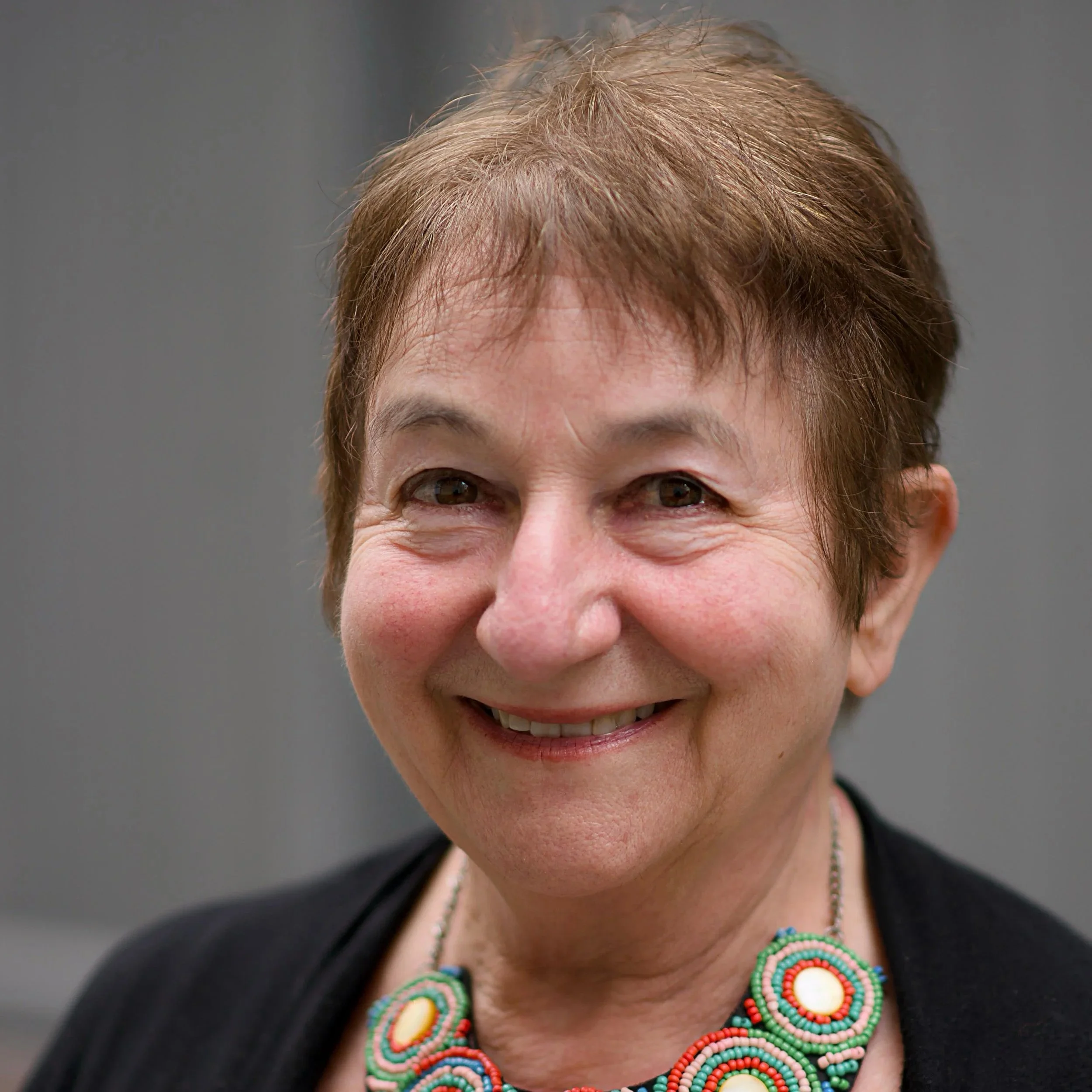
Georgia Katakou and Kate McNamara talk with Ros Schwartz, an award-winning translator from French who has translated over 100 works, and has been awarded a Chevalier de l’Ordre des Arts et des Lettres by the French government.
Our conversation explores her recent translation Venice Requiem by Khalid Lyamlahy, and moves into discussions of pitching to publishers, translating across mediums, and the re-translations of Antoine de Saint-Exupéry’s The Little Prince, and Jacquline Harpman's I Who Have Never Known Men. We also ask her about the notion of hospitality as a translator, in relation to her translation of one of our favourite books on translation: Translation as Transhumance by Mireille Gansel.
[Photo credit: Camila Franca]
Kate McNamara:
Hello Ros! Georgia and I are very pleased to welcome you to the Talking with Translators Series. We have long been fans of your work, and particularly love your translation of Mireille Gansel’s Translation as Transhumance, which has been a guiding light for our own discussions of translation. Thank you for taking the time to talk with us today. We’re excited to hear your thoughts, and to discuss your latest translation, Venice Requiem, by Khalid Lyamlahy. How did you come to translate Venice Requiem? What was your connection with it?
Ros Schwartz:
It's one of those lovely stories about how a book finds a translator. There's a kind of ecosystem of like-minded literary critics, authors, translators, and this book came via a journalist and literary critic, Olivia Snaije. She was blown away by this book and asked the author, Khalid Lyamlahy whether it had been translated into English. It hadn’t. so Olivia encouraged him to send it to me. There was something about his message to me that was very humble, so I agreed to have a look at his book. Like Olivia, I was blown away by it. It has only happened to me three times in my entire career that I've read a book and thought, I have to translate this. This was written for me to translate. So I wrote a report and sent it to Pete Ayrton of Hope Road. I have worked with him before – he published my translations of Max Lobe, the Swiss-Cameroonian writer. Hope Road’s imprint Small Axes felt like the perfect home for this book. And Pete agreed to do it. I'm really happy to see the book out in my English translation, because this has been a real passion project for me.
Kate McNamara:
That’s really so nice to hear. It must be a wonderful thing to work on a translation of a book that you feel so strongly about. What was it that drew you to the book?
Ros Schwartz:
The humanity of it, particularly at this time where we're living in this hostile environment towards refugees; it felt like the antidote we all need. The way it humanises somebody who was just a nameless, faceless refugee feels very important. And it was humbling to read. Also the writing: the language is absolutely exquisite and Khalid knits together so many themes. I thought that this was a really unique and important book.
Georgia Katakou:
This is the first work of Khalid Lyamlahy to be translated into English. What was your working relationship with the author like?
Ros Schwartz:
Very close. Khalid teaches at the University of Chicago and his English is extraordinarily good. He was really interested and willing to be involved in the translation process (which not all authors are) so I was able to go to him with questions. He read the various drafts. This translation went through umpteen drafts; he read them all and responded immediately. Most importantly, he was able to put his finger on anything that wasn't working. We were able to brainstorm together where I had to go for a solution that moved away from the French. But he completely understood that. He gave me carte blanche because he understood that to get this book into English was quite challenging. It was a very close and very fruitful relationship.
Kate McNamara:
I would love to have been able to listen in on some of those conversations, and to know the debates over word choices that exist behind the final text that we read. One example that I can ask you about is the title - the English (Venice Requiem) is quite different from the original French title (Évocation d'un mémorial à Venise). Did you come up with the title Venice Requiem or is it something that was suggested by the publishers?
Ros Schwartz:
The title in French was not going to work if I translated it literally – ‘the evocation of a memorial in Venice’ doesn't trip off the tongue! English titles need to be quite short and punchy, and the title has to somehow sum up the essence of the book. So we had a lot of to-ing and fro-ing with Khalid and with the publisher over this, because the word had to be in the title was ‘Venice’, partly for commercial reasons maybe. In fact, I was in a bookshop yesterday and I found the book on the shelf under “Tourism, Italy!” ‘Death in Venice’ was obviously not an option. We wanted to preserve this sense of memorial, but in English a memorial tends to be a very physical thing: it’s a stone memorial to the war dead, et cetera. So I thought of ‘requiem’ because in a way the book is a sort of requiem for the dead. It's a hymn to Pateh. And that worked. So there are points in the text where it refers to a ‘mémorial’, and I translated that as ‘requiem’ to echo the title. But it took weeks of discussion to find the right title.
Kate McNamara:
Well, I'm really pleased to hear that because I know that often publishers or marketing teams decide on the title of translated works, and we have spoken to other translators who tell us they had no say at all over the title of their book.
Ros Schwartz:
No, no. This was very hands-on, all of us.
Georgia Katakou:
I was struck by what you were describing here, the memorial as a physical structure. Something that I found very interesting about Venice Requiem is the way it takes on this task of memorialisation, drawing the built space of the city and its watery, unsteady foundations into his narrative. Lyamlahy blends fact and fiction, memory and speculation. The book is part confession, from the author who develops a strong connection to Pateh, a 22-year-old Gambian refugee who died in Venice's Grand Canal in 2017, and part conversation with Pateh himself. Describing Venice’s bridges, Lyamlahy speaks to Pateh directly, telling him how: ‘You won’t have the time to see them, but they will ensure that snippets of your tragedy are spread. Your lagoonal solitude amplified by the city’s architectural unity.’ The text also veers into a very matter-of-fact re-telling of facts about migratory movements in both the present moment and the past. How did you approach this particular work with its different elements and voices? Were there any challenges (large or small) in bringing this text into English?
Ros Schwartz:
One of the interesting things about this book is that Khalid is questioning himself as a writer throughout. He didn't set out to write a book. He read about Pateh’s death and he just started collecting information – newspaper articles, interviews – and thinking about this whole episode. And then he realised that he had a book and started to write it. But at the same time he was questioning his own ethics about it, wondering who am I to tell someone else's story? How can you tell this kind of story? So interwoven with the facts, there's his introspective voice all the way through: What am I doing? How can I do this? How do you write about something like this? His technique is to have separate paragraphs. Sometimes he addresses Pateh directly, at others he's questioning himself, and talking to the reader about his doubts. Then again, he weaves in historical connections. So the structure was there for me. I just followed Khalid’s paragraphing and language register.
One of the things that Khalid does – we had a conversation about this, and it's very French – is to start a sentence with an infinitive. So he'll just say ‘to write’ or ‘to dream’, and in English you have to say who's writing, who's dreaming? I had to take some liberties there and change the sentence to have a subject. How do I write? How do you know? We discussed this, and I had Khalid’s permission to do what I needed to do to make the English text work. Because he knows English so well, he understands the differences between English and French. Of course, the other thing is that English has this very rich vocabulary of Anglo-Saxon based words and Latinate words, and French can sound much more literary simply because it is rooted in Latinate language. I had to work very hard to make the language flow in English in a way that sounded natural and not pretentiously literary.
Kate McNamara:
As you said, one of the striking features of this book is its introspection. Lyamlahy repeatedly contemplates the ways in which writing is not enough: ‘That sweet illusion when writing believes itself capable of connecting fragments separated by miles of borders or years of silence. To write about your story, I have to take account of the limitations of writing, recognise the part that is lacking, incomplete, the gaps in each fragment’, and he also frequently questions his own abilities to tell the story of Pateh, even as he tells it: ‘I think I can hear the painful lament of the gondolas as each oar stroke plunges your story a little deeper in the fathomless depths of the waters.’
Did working on this book make you reflect on the process of translation as a form of writing, and on its limitations or potential advantages in relation to the story of Pateh or more broadly?
Ros Schwartz:
Well, when you’re translating, you're trying to capture the voice. When you work very closely on a book for a long time, you start to become inhabited by it. And also, having met Khalid and spoken with him and heard his voice, what I was trying to do was to get as close as possible to what I experienced as the author's intention, saying to myself, if he were writing in English, what is the voice he'd have? I have to ventriloquise him in English, using everything in the writer's toolbox that is available in English. Translation is a lot about rhythm and music. You're not just translating the words on the page, you're translating the intention behind them, underneath them, the unspoken. You are also finding a rhythm and a music in the language. I often find that with Arabic authors who write in French it's almost like translating an Impressionist painting. English tends to be a bit more concrete. So sometimes you read the words in French – they're exquisite, they're beautiful – but you can't quite pin things down. So it can be quite challenging pinning down that impressionistic picture.
Kate McNamara
It works so beautifully as a translation, but I’d love to hear you speak more about this transferal from the impressionistic French to the more concrete English. There must have been moments in the process of translation when you were faced with the constant refrains of the text on the limits of writing. And in the process of translation you almost have to confront that idea on two fronts – both the limitations of writing in telling a story like this, and also the limitations you must sometimes feel when you need to translate that impressionistic feeling that you got from the French across into the English…
Ros Schwartz:
My method is to read out loud all the time. I’d translate a paragraph, then fiddle around with it, play with it, and read it out loud over and over again just listening to the sound and the rhythm. I’d look at what I could do to make it sound elegant in English while conveying the author’s intention.
Georgia Katakou:
Something that I found really central to Venice Requiem is its concern with history and its wrongs, and primarily the erasure of disenfranchised historical actors. It seemed to me that one of the forces within the text is a desire to restitute the forgotten. What role can translation and translators play in reimagining history?
Ros Schwartz:
I don't know about reimagining history, but I think what translation can do and does all the time is open doors. I learnt so much translating this book. There were lots of historical facts I didn't know. Translation can echo what the authors are doing and what their intentions are by bringing untold stories to the reader.
By choosing the books we translate, translators have the role of agency, to champion important stories that need to be heard. Obviously, a book that is translated into English has a worldwide market. Most of the time translators are commissioned by publishers, but we can also be proactive in taking books to publishers that we think deserve attention.
Kate McNamara:
Absolutely. And all the more so when you have a strong voice, and you have become an established and respected translator. I feel that, as an emerging translator, there's this idea that pitching feels quite difficult and unlikely.
Ros Schwartz:
Actually no, I would say that there are publishers who are open to pitches because there is increasing recognition that it is translators who alert publishers to interesting works. We've seen that with the International Booker – very often the winners are books that have been discovered by translators: Flights by Olga Tokarczuk (translated by Jennifer Croft), or Heart Lamp by Banu Mushtaq (translated by Deepa Bhasthi). These are books that their translators discovered. And if you look at the submissions to English Pen's translation fund, the publishers have to say how they encountered the book, and very often it had been brought to them by a translator. So if emerging translators pitch professionally (and there's all sorts of support available, for example Anton Hur’s guide), and you've come across something really special, then the doors aren't closed because publishers are aware they can't read everything from every language. A lot of publishers now recognise that translators have an important role to play.
Kate McNamara:
That's encouraging to hear. Talking about the influence that you can have as a translator on what books people read, I was wondering about your recommendations for people who want to read further after Venice Requiem which is based in Venice but spends much time thinking about Africa, particularly Gambia where Pateh was from. Lyamlahy addresses Pateh in the book and says that ‘this writing is condemned to the to-ing and fro-ing, to the endless wandering between the river of your home country and the canals of the country of others. It is a writing of oscillation and vertigo.’ – Venice Requiem moves between Europe and Africa in imagination only; Pateh’s home country of Gambia is conjured through images, imagination, and online research. You have translated a number of Francophone African writers – for readers who would like to follow on from this book and read more stories coming from Africa, what or who would you recommend?
Ros Schwartz:
One thing I'd say about what Khalid is doing here is, as somebody who is from North Africa, he wanted to make a connection with sub-Saharan Africa and draw on common shared histories. It was very important for him to make that connection.
I've got quite a list of books by African writers! And not all translated by me. I’d recommend: Fiston Mwanza Mujila (DRC), Tram 83 and The Villains Dance, both translated by Roland Glasser; Gaël Faye (Rwanda), Small Country translated by Sarah Ardizzone; Max Lobe (Cameroonian/Swiss), A Long Way from Douala and Does Snow Turn a Person WhiteInside, translated by myself; Just Like Tomorrow, Men Don’t Cry or Discretion by Faïza Guène (French Algerian), translated by Sarah Ardizzone; Belly of the Atlantic by Fatou Diome (French Senegalese), translated by myself and Lulu Norman; Standing Heavy by GauZ’ (Côte d'Ivoire) translated by Frank Wynne; Véronique Tadjo (Côte d'Ivoire) In the Company of Men.
Georgia Katakou:
Thank you! What a list. You translated Ousmane Sembene’s Black Docker. Sembene is known as the father of African cinema. His film work has been incredibly influential. It made us think about your process of translation. Do you look into other works by the person you're translating? Did you watch any of Sembene’s films when translating this novel, for example?
Ros Schwartz:
Black Docker was one of the first books I ever translated, and I knew nothing about translation, and I knew very little about Ousmane Sembene. I had no idea how publishing worked, and I just took myself to the Frankfurt Book Fair. I saw this book on the Présence Africaine stand, and I knew that he was an important writer. I enquired whether the book had been translated, and was told it hadn't. And I asked if I could pitch it to English-language publishers? And they said yes. So I took it to Heinemann, who had an African Writers series at the time. They had done all of Sembene’s other books and somehow missed that one. And to my amazement, they commissioned me to go ahead, translate it! I hadn't seen his films and this was back in the early 80s. You couldn't easily get access to films. But I will say that when I translate a writer whose books have been made into films, I don’t watch the film because it would superimpose itself on the film in my head and influence my translation. Interestingly, Black Docker is going to be republished and I'm going to revise my early translation.
But as to your question: do I read other works? Very often, there isn't the time. I do if I can. But I look at each book as an entity on its own. I have translated several works by one or two writers, including Georges Simenon, and it has enabled me to really grasp what that writer is about, which you don't necessarily get from one book. But each book has to be seen as a standalone.
Kate McNamara:
Thinking more about the film-book connection, have you ever translated across any other mediums?
Ros Schwartz:
I've done film subtitling and plays, and I've done a manga version of Camus’ L'Étranger . . .
Kate McNamara:
No, really? I didn’t know about that. I'm going to look it up!
Ros Schwartz:
Yes! It's published by Penguin and is called The Outsider, adapted into manga by Ryota Kurumado.
Kate McNamara:
That's great. How do you feel translating for other mediums in comparison to books?
Ros Schwartz:
I love doing theatre because it's dialogue. Also with theatre, you're only one of the translators. There's the director, there are the actors. So it's really interesting. I work off the page and I might not have seen the play in the original. All I've got is the words in front of me. And then the director interprets the translation as their vision. And when the words get into the mouths of actors, they might adapt it again. So it's a work in progress, and I like the collaborative aspect. Film subtitling is a different challenge because you've got technical constraints, such as a limited number of characters per title. It's a very good discipline for being concise.
Kate McNamara:
But frustrating I imagine, as well.
Ros Schwartz:
No! But the challenge is that the French sometimes speak very fast and you've got this extensive dialogue that has to be condensed.
I also used to translate for the National Film Theatre when they showed foreign films that hadn't been subtitled. Because they were only showing them once and getting them subtitled in those days was very expensive, they would have live interpreters! I'd be sitting up in a booth with headphones on, listening to the film, seeing the film through a little window and speaking at the same time, which was . . .
Kate McNamara:
Terrifying?! Interpreting is a whole different skill.
Ros Schwartz:
It is. I don't do it. Interpreters think on their feet, and they forget what they've said the minute they've said it. They don't have time to ponder. With translation, you can go over it. You've got weeks, months to rethink your translation. With interpreting, it goes in and comes out immediately, and is instantly forgotten. I did do a one-day course, just out of curiosity, to see what interpreting was about. And one of the things I learned is that interpreters tend to be very visual people. They don't take written notes, they draw; they do a sort of mind map. And so they have a very visual brain. I don't have a visual brain. I can't even work a washing machine if it has only got symbols. I need written instructions. So interpreting requires a very different sort of brain and also the ability to let go. Translators are nitpicky and we go over stuff and we worry endlessly. Interpreters have to let it go.
Georgia Katakou:
You mentioned the re-publication of Black Docker and that you are revisiting your own translation of it. We're very curious to hear more about your experiences working on re-translations as opposed to first translations. This relates to both revisiting your own work, and also translating something again that was initially translated by someone else.
Ros Schwartz:
There are two main re-translations I’ve done of works that were previously translated by other people: there's The Little Prince and there are the Simenon novels. For these, I don't look at the previous translations because if I did, I’d be influenced one way or another. It would either make me feel that I had to do something radically different or that the existing translation was so amazing that I couldn’t think of anything better. So I have to treat re-translations just as I would any book. I have looked afterwards at previous translations though. And in fact, when I do the Simenon books, because some of them are quite antiquated and there are things I sometimes just don't know, but when I look, I find that the translator has left that bit out! So they were stuck too!
As regards re-translations of my own work, in 1997, I translated a book called Moi qui n'ai pas connu les hommes and it was published as The Mistress of Silence (not my title!). At the time this book t went nowhere. I mean, it died a death. In 30 years, it sold about ten copies. Then in 2019/20, Vintage contacted me and said they wanted to republish it. And I wondered why. But that was their business. And I said, if you're going to republish it, I need to have a look at the translation because it's old and I was a beginner. So they sent the translation to me and it was excruciatingly bad. And I thought, how did they publish this? It hadn't been edited. I'd made every beginner translator's mistake in the book. It was toe-curlingly awful. I told the publisher that I would have to completely redo the translation, which I did. It was interesting! I have written about this, actually [you can read it here]. It was interesting to see how I had evolved as a translator and hopefully improved. But also I was amazed that the publisher had been happy to republish it and not think about whether it was any good. I do think that the re-translation was an improvement.
Kate McNamara:
We’re talking here about Jacqueline Harpman’s book, which has now been republished as I Who Have Never Known Men. When you re-read the work, did you have any sense that it was going to have the runaway success that it has had?
Ros Schwartz:
No. I was just utterly flabbergasted. I thought, yes, it's a good book. It's a good story. I wasn't blown away by it. But it somehow seems to touch a chord with Gen Z. It was perhaps the wrong book at the wrong time when it was first published, and a bad translation to boot, with no publicity.
Kate McNamara:
And now it won't stop selling in our bookshop!
Ros Schwartz:
And globally. It's top of the bestseller lists all over America, India, New Zealand, Canada. It appears to tap into something very profound in readers.
Georgia Katakou:
Could I ask a question here – you mentioned a couple of times this relationship between the translator and the editor, as well as the quality of the editing. Could you speak a little bit to us about that because I feel that I very rarely read about the work of editors in translation, and I would be very curious to hear more from you on that.
Ros Schwartz:
It depends on the publishing house, but the normal process is that you have the overall commissioning editor who will read the translation and come back with a few comments, but just minor things. And then it goes to a copy-editor, and the copy-editor’s job is to make sure that grammar, punctuation, spelling, etc. are all correct. Good copy-editors are brilliant because they don't intervene unnecessarily but save you from your mistakes. They will conscientiously fact-check, which authors don't necessarily do. As a translator, I do as much fact-checking as I can – if the book is set in a particular place, I'll look up all those streets and make sure that I've got the descriptions correct, for instance. But the copy-editor will pick up mistakes that are sometimes in the original, and if the author's alive, you can go back to the author and say does this person have blue eyes or brown eyes? The copy-editor will normally work using track changes so every change is visible. They'll suggest punctuation, or they'll put in little comments saying I didn't quite understand what's going on here. Can you have another look? Sometimes I've made a mistake and I've misread something; sometimes the query relates to the original. Something might need rephrasing for clarity and the copy-editor might make a suggestion. So it's a collaboration and it's a really important collaboration. I've learned almost everything I know from good copy-editors. They'll pick up repetitions, or sometimes you're groping for a word, and you know that there's a better word but you just can't think of it. And the copy-editor will say, did you mean this? So it's a really important stage, not only in translation, in original writing as well. That's in an ideal world.
Translations can be different from working on an original English book because there's the original author, and if the original author is doing something weird – say they're playing with punctuation or paragraphing – as a translator, you have to take your cue from the author. But the copy-editor might not be aware of this. I always put notes to the copy-editor to pre-empt queries, e.g. there's a pun in French here. It doesn't quite work. So I've done this. Or the copy-editor might pick up on things that are culturally specific and might need glossing a little bit. It’s what we call stealth glossing in translation. So for example, with food: if somebody's having a boeuf bourguignon, if you keep it as ‘boeuf bourguignon’, the reader who doesn't know French food might be confused. As a translator, you might gloss it in the next sentence by saying the waiter brought the steaming beef stew, so you can work in little glosses like that. And it's a big controversy with publishers, how much you help the reader. The trend amongst translators nowadays is that readers are not stupid. They can work stuff out. But yes, the editing is an important stage. The question is, who has the last word? And on the whole, it should be the translator. An ethical publisher might query something but if you say No, no, I absolutely want to keep this then they’ll listen. An example in Venice Requiem was that Khalid used the word ‘lagunaire’ to refer to the lagoon, and it was a reference to the writing of Aimé Césaire. In English there's the word ‘lagoonal’, which is what has been used in the translations of Césaire, but it's quite obscure. We agreed that it was important to keep that word in. So there can be a lot of to-ing and fro-ing at the editing stage. In an ideal world, you have a very close relationship with a copy-editor, and there's a mutual respect.
Kate McNamara:
We’re coming towards the end of our questions, but before we do, we’d like to touch on your translation of Mireille Gansel’s Translation as Transhumance. This is a beautiful work that has inspired us a lot in our conversations around translation. In the context of this work, you have spoken about the act of translation as hospitality and the translator as a host. In your translation of Translation as Transhumance, Gansel also describes how ‘an author being open to being translated is “the essence of hospitality”’. If the translator is the host, what are some of the expectations and responsibilities that fall upon her?
Ros Schwartz:
Hospitality is being open to the other. And translation is being open to the other and also being open to being challenged. I've found some of the writers I translate – particularly Dominique Eddé, the Lebanese writer – push me way out of my comfort zone. So it's being open to a different literary genre, a different style of writing. Writers from Arabic cultures don't follow the traditional Western narrative arc, their books are more like mosaics. The way Dominique writes, there's a lot of that Impressionist painting type of feeling. So hospitality defines the translator’s role: you're bringing literature across borders and giving readers access to entirely different cultures.
Kate McNamara:
I hadn't really thought about hospitality in terms of being challenged. I like that idea, that not just the words that they have written will challenge you, but also the authors themselves and the interactions you have with them can also push the boundaries of your hospitality. It must be quite a balance, as the translator sometimes.
Ros Schwartz:
Yes. As a translator, you have to be open.
Georgia Katakou:
Here’s a question that we like to ask in our interviews: are there soundtracks to the works you translate, with music either from the language or the culture that the book is steeped in, or with music suggested by the writing itself? Or perhaps you had certain music playing on repeat whilst working on the text? Is there an unheard sonic background to Venice Requiem?
Ros Schwartz:
So my sonic background is silence. I don’t listen to music when I’m working. I've asked this question to fellow translators and some people like to work to rave music. I need absolute silence. But when I'm translating a novel with lots of references to music, I do listen to that music. Max Lobe’s novels, for example, are full of music so I listened to the songs he mentions. I did actually meet with Max in Switzerland when I was translating A Long Way from Douala. We were working in the library of the Looren Translation House, and he would suddenly seize me and dance me around the room to a Makossa number. In Kamal Jann, Dominique Eddé writes about Bach’s Goldberg Variations played by Glenn Gould. I listen to the music when it's mentioned, but otherwise I work in silence.
Kate McNamara:
Absolutely. I love it when you can create soundtracks around books because the author has woven the music into the text.
Ros Schwartz:
I think we actually created a playlist for Max because he mentioned so many different kinds of music. We produced a playlist, which sadly did not find its way into the published book.
Kate McNamara:
I listened to an interview of you and Max Lobe together, and he sounds like a lot of fun. There was so much laughter.
Ros Schwartz:
He is a hoot. Absolutely, yes! [Laughter]
Kate McNamara:
We're also building an online library, built from recommendations by the translators that we interview. So we always ask, is there a piece of writing that has guided you during a translation work? Is there a text, or even just an idea, that you keep coming back to?
Ros Schwartz:
I think it's more conversations with other translators that have guided me. I haven’t read the big translation theorists. I've absorbed them by osmosis from being an external examiner and reading MA dissertations. So I'm familiar with some of the theory, and it's quite useful for articulating my own practice. I think one thing I would recommend is Walter Benjamin's ‘The Task of the translator’, which is in Illuminations. There are things he says in that essay that just sum up a lot of my own practice, particularly this quote:
In the appreciation of a work of art or an art form, consideration of the receiver never proves fruitful. Not only is any reference to a certain public or its representatives misleading, but even the concept of an ‘ideal’ receiver is detrimental in the theoretical consideration of art since all it posits is the existence and nature of man as such. […] No poem is intended for the reader, no picture for the beholder, no symphony for the listener.
Georgia Katakou:
That’s fascinating! And finally, is there a book that has been translated into English that you would recommend? And what is a book that has not yet been translated into English that you think absolutely should be.
Ros Schwartz:
That has been translated? I would recommend Sarah Ardizzone’s translation of Discretion by Faïza Guène. Any of her translations of Faïza Guène, in fact.
And the book that hasn't been translated, which I would very much like to find a publisher for, is Dominique Eddé’s Le Palais Mawal, which is her latest novel. Looking for a home!
Kate McNamara:
Wonderful. Thank you. It has been such an honour to talk with you and to hear some of your thoughts on translation, and all these books.
Ros Schwartz:
Thank you.
